


Soil test results provide the engineering evidence needed to translate an understanding of ground conditions into foundation dimensions, settlement predictions, construction methods, and quality-control requirements. Their value depends not simply on the measured numbers, but on how engineers interpret them alongside the soil profile, groundwater conditions, structural loads, and the limitations of each test method.
This article explains how geotechnical data influence foundation selection, bearing resistance, settlement analysis, ground improvement, and construction verification. It also examines practical ways to identify inconsistent results, manage unexpected ground conditions, and connect laboratory testing with field observations throughout a construction project.
How Soil Test Results Establish the Basis for Foundation Design
Foundation design begins with a ground model: an engineering interpretation of the soil and rock layers, groundwater conditions, and relevant variations across the site. Soil test results provide the evidence used to develop this model. Borehole records, sample descriptions, laboratory measurements, and in-situ test data are evaluated together to determine which ground conditions may control foundation performance.
For example, a site may contain a relatively dense surface layer over soft clay. A shallow foundation might appear feasible if only the surface material is considered, but the underlying clay could compress under the building load and cause excessive settlement. Conversely, a relatively weak surface layer may overlie a competent stratum that can support a different foundation arrangement. The important question is therefore not simply whether the soil is strong, but how the entire soil profile will respond to the proposed structure.
Engineers also need to understand how representative the available data are. Soil properties can vary laterally and with depth, and a test result from one borehole cannot automatically be applied to every part of a large site. The investigation should provide sufficient coverage to identify relevant changes in stratigraphy and properties, particularly beneath heavily loaded columns, core walls, retaining structures, and other critical foundation locations.
|
Soil investigation result |
How engineers use it |
Potential design decision |
|
Soil classification and index properties |
Identify material types and potential behavioral differences |
Establish soil layers and determine additional testing needs |
|
Shear strength parameters |
Evaluate resistance to shear failure under relevant conditions |
Assess bearing resistance and stability |
|
Compressibility and consolidation data |
Estimate settlement under changes in effective stress |
Select foundation type and evaluate serviceability |
|
Groundwater observations |
Assess pore pressure, excavation conditions, and groundwater-related risks |
Plan drainage, dewatering, and construction sequencing |
|
In-situ penetration or loading measurements |
Characterize changes in ground response and support interpretation of soil properties |
Refine the ground model and assess foundation alternatives |
|
Compaction and density results |
Verify the condition of engineered fill or prepared ground |
Determine whether construction acceptance requirements have been met |
The FHWA Geotechnical Engineering guidance provides further context on the role of subsurface investigation and geotechnical information in engineering design. In practice, the ground model should be updated when new observations or test results reveal conditions that were not adequately represented in the original interpretation.
How Soil Strength Test Results Influence Foundation Bearing Resistance
One of the main uses of soil test results is to evaluate whether the ground can resist the loads transferred by a foundation. The relevant analysis depends on foundation geometry, soil strength, groundwater, loading conditions, and the potential failure mechanism.
Laboratory strength tests and appropriate in-situ investigations help engineers establish parameters for evaluating bearing resistance. For cohesive soils, the distinction between short-term undrained behavior and long-term drained behavior can be particularly important. For granular soils, frictional resistance, density, stress level, and groundwater conditions may influence the assessment.
A critical distinction is that a laboratory strength value is not itself an allowable foundation pressure. Engineers must interpret the measured properties through an appropriate design method and account for the applicable safety format, loading conditions, and governing design requirements.
Distinguish Ultimate Bearing Resistance from Allowable Pressure
Ultimate bearing resistance describes the ground's resistance at a defined failure condition. Allowable pressure or design resistance is determined according to the applicable design framework, which may involve safety factors or partial factors and other checks. A foundation that satisfies a bearing-resistance calculation may still be unsuitable if settlement exceeds acceptable limits.
Consider a building founded on a layer of dense sand overlying compressible clay. The upper layer may provide adequate resistance against a local bearing failure, but the deeper clay could undergo substantial consolidation as the building load increases. In this situation, the design must consider both strength and deformation rather than relying on the apparent quality of the upper layer.
Account for Groundwater and Effective Stress
Groundwater conditions influence the stresses carried by the soil skeleton and may change the interpretation of strength and settlement parameters. In saturated soils, effective stress is related to total stress and pore-water pressure. Changes in groundwater level can therefore affect soil behavior, especially in granular deposits and compressible fine-grained layers.
A groundwater observation made during drilling should not automatically be treated as the permanent design water level. Seasonal variation, recent rainfall, nearby pumping, and perched groundwater can all affect observations. Where groundwater materially influences design, engineers should assess whether additional monitoring or investigation is needed.
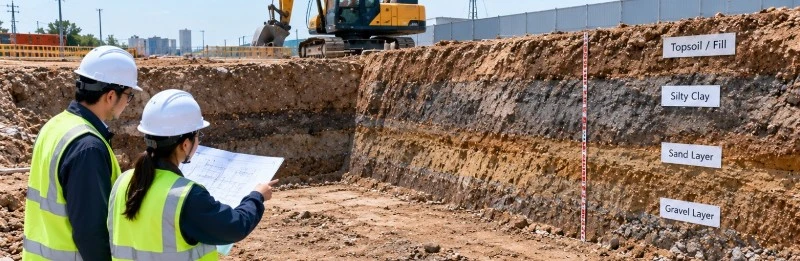
Foundation excavation provides an opportunity to compare the exposed ground with the assumptions used during design. Unexpected soil layers, seepage, or disturbed material should be assessed before foundation construction proceeds.
How Soil Test Results Are Used to Predict Foundation Settlement
Settlement is often a controlling factor in foundation design because excessive or uneven movement can damage finishes, distort structural components, and affect the serviceability of a building even when the soil has adequate bearing resistance.
Engineers generally distinguish between immediate settlement, consolidation settlement, and longer-term deformation mechanisms where relevant. Immediate settlement may be important in granular soils and in undrained response, while consolidation settlement can dominate in saturated fine-grained soils as excess pore pressure dissipates over time. The relative contribution of each mechanism depends on soil type, stress history, drainage conditions, foundation geometry, and loading.
Use Compressibility Data and Stress Changes Together
Consolidation test results help engineers evaluate how a compressible soil layer responds to an increase in vertical effective stress. The interpretation must consider the initial stress state, the additional stress imposed by the foundation, the thickness of the compressible layer, and the relevant compressibility parameters.
The stress increase beneath a foundation does not remain constant with depth. Engineers therefore estimate how the applied load influences each relevant layer and assess the deformation contribution of those layers. The predicted settlement is then compared with project-specific serviceability criteria.
A common mistake is to focus only on the total settlement at the center of a foundation. Differential settlement-the difference in movement between locations-may be more damaging to a structure. Variations in soil thickness, foundation loading, construction sequence, and local groundwater conditions can produce uneven movement even when average settlement appears acceptable.
Interpret Settlement Predictions with Appropriate Caution
Settlement calculations are predictions based on a ground model and selected parameters, not guarantees of actual field behavior. Uncertainty can arise from sample disturbance, spatial variability, simplified stress distributions, changes in groundwater, and construction conditions that differ from the design assumptions.
Where predicted settlement is sensitive to a particular parameter, engineers should review whether the available investigation provides sufficient evidence for that parameter. Additional testing or more detailed analysis may be justified when the consequence of error is significant. The goal is not to eliminate all uncertainty, but to understand which uncertainties could materially affect the design.
How Soil Test Results Guide Foundation Selection and Ground Improvement
Soil investigation results help engineers compare foundation alternatives. Shallow foundations may be appropriate where near-surface soils provide adequate resistance and settlement can be controlled. Where weak or highly compressible materials extend to significant depths, engineers may investigate deep foundations or ground improvement. The appropriate solution depends on structural loading, the depth and continuity of suitable strata, construction access, groundwater, cost, and project constraints.
|
Ground condition identified |
Engineering concern |
Possible response for evaluation |
|
Competent soil near foundation level |
Bearing resistance and settlement must satisfy design requirements |
Consider a suitable shallow foundation |
|
Thick, compressible clay |
Long-term and differential settlement |
Assess settlement mitigation, ground improvement, or deep foundations |
|
Variable fill or poorly controlled ground |
Uncertain support and uneven deformation |
Investigate fill thickness and quality; assess removal, replacement, or improvement |
|
High groundwater or seepage |
Excavation stability and construction feasibility |
Evaluate drainage, dewatering, and temporary works requirements |
|
Weak layers beneath a stronger surface crust |
Potential deeper deformation or failure |
Extend investigation and evaluate the full stress-influence zone |
These are possible responses rather than automatic prescriptions. For example, replacing weak soil may be practical for a shallow, localized deposit but uneconomical where the weak layer is deep or widespread. Deep foundations may transfer loads to a more competent stratum, but their design must still address settlement, load transfer, installation effects, and the behavior of the surrounding soil.
Engineers should also consider how a proposed improvement method will be verified. If an improvement specification requires a target density, stiffness, or load-settlement response, the verification plan must identify the appropriate test method, acceptance criteria, testing locations, and frequency before construction begins.
Tianpeng's Soil Testing Equipment category provides a starting point for reviewing equipment relevant to geotechnical laboratory and field testing. The equipment selected for a project should support the required testing procedure and acceptance criteria; no individual instrument can replace the engineering evaluation of the ground model and design alternatives.
How Soil Test Results Support Construction Quality Control
Soil testing remains important after the design has been completed. During construction, test results and field observations help confirm whether the exposed ground, engineered fill, and completed foundation preparation are consistent with the design assumptions.
For engineered fill, laboratory compaction results establish a reference relationship between moisture content and dry density for the specified compaction procedure. Field measurements can then be compared with the project's acceptance requirements. The correct reference method must be used, and results should be interpreted alongside lift thickness, material type, moisture condition, and the compaction process.
For foundation excavations, the responsible engineer or geotechnical professional should compare exposed conditions with the ground model. If the actual bearing stratum is weaker, more variable, or wetter than expected, the difference should be documented and assessed before concrete is placed or the foundation is otherwise concealed. Proceeding without review can make later investigation difficult and may create expensive remediation work.
Establish Hold Points and Acceptance Criteria Before Work Begins
A practical construction quality plan identifies when testing or inspection is required and who has authority to accept the results. For example, a project may require inspection of the foundation formation before blinding concrete is placed, or verification of each specified fill layer before the next lift is constructed.
Acceptance criteria should be defined in the project documents rather than improvised after results are obtained. Reports should identify the test location, depth or layer, date, method, relevant measurements, and the acceptance decision. Where results fail to meet the criteria, the project team should record the nonconformance and agree on corrective action, which may involve reworking the material, further investigation, or engineering review.
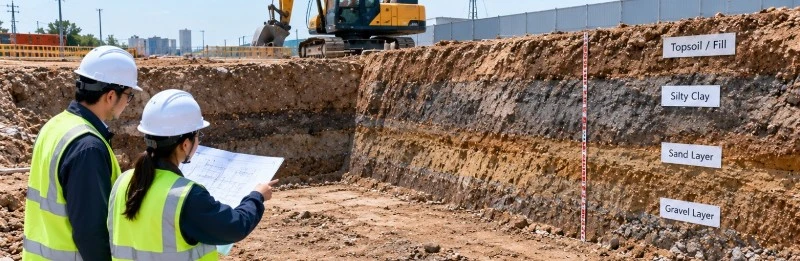
Construction-stage verification helps determine whether the ground exposed on site matches the design assumptions. Documented inspections and test results provide a traceable basis for acceptance or corrective action.
What Should Engineers Do When Field Conditions Differ from Test Results?
Differences between predicted and observed conditions do not necessarily mean that the original tests were incorrect. They may indicate natural soil variability, insufficient investigation coverage, changes in groundwater, sample disturbance, or a construction process that has altered the ground.
The first step is to document the discrepancy and check whether the test result is reliable. Engineers should review the test location, sample identity, method, equipment condition, and field observations. They should then determine whether the discrepancy is localized or may affect a wider area. Depending on its significance, the response could involve additional sampling, supplementary field tests, revised parameter selection, or reassessment of the foundation design.
Changes to foundation dimensions, ground improvement, or construction procedures should be made through the project's engineering review and approval process. Field personnel should not assume that a seemingly small difference is harmless, nor should they change a design solely on the basis of an isolated measurement without considering its context.
Equipment and documentation quality support this process. Tianpeng's broader Material Testing Equipment category can help laboratories explore testing solutions for construction materials, but actual suitability must be established against the specific method and project requirements. Where equipment conformity is relevant to the intended market, the European Commission's CE marking guidance explains when CE marking applies under EU product legislation. It should not be treated as a substitute for appropriate test procedures, calibration or verification, or competent engineering interpretation.
Summary and Recommendations
Soil test results influence nearly every major stage of foundation engineering, from developing the ground model and evaluating bearing resistance to predicting settlement, selecting foundation alternatives, and verifying construction quality. Their value lies in the relationship between the measured properties and the actual engineering problem.
Engineers should interpret soil strength together with compressibility, groundwater, stratigraphy, and the proposed loading conditions. They should distinguish between bearing resistance and settlement requirements, recognize the uncertainty associated with sampling and spatial variability, and ensure that construction-stage checks are planned before work begins.
The most effective approach is to maintain a clear connection between investigation data, design assumptions, construction observations, and acceptance records. When actual conditions differ from expectations, document the discrepancy, investigate its significance, and obtain the appropriate engineering review before making changes. This process helps reduce the risk of unexpected settlement, unsuitable foundation solutions, and costly construction delays.
Frequently Asked Questions (FAQ)
1. Why are soil test results important for foundation design?
Soil test results help engineers characterize the ground, estimate strength and compressibility, assess groundwater effects, and evaluate possible foundation solutions. They provide the evidence needed to develop design parameters and identify conditions that could cause bearing failure, excessive settlement, or construction difficulties.
2. Which soil properties are most important when designing foundations?
The relevant properties depend on the site and foundation type. Common considerations include soil classification, shear strength, compressibility, density, permeability, groundwater conditions, and the thickness and continuity of each layer. No single property is sufficient for every design decision.
3. Can soil test results determine foundation type by themselves?
No. Test results inform the decision, but engineers must also consider structural loads, foundation geometry, settlement limits, site constraints, groundwater, construction methods, and applicable design requirements. The final choice requires an integrated geotechnical and structural assessment.
4. What happens if the soil encountered during excavation differs from the investigation report?
The discrepancy should be documented and reviewed before the affected work proceeds. Engineers may need to verify the observation, carry out additional investigation, revise the ground model, or evaluate changes to the design or construction method. The appropriate response depends on the significance and extent of the difference.
5. How are soil test results used during construction quality control?
They help verify that foundation formation and engineered fill meet the project's requirements. Field tests, inspection records, and laboratory reference data are compared with predefined acceptance criteria. Results that do not comply should trigger documented corrective action or engineering review rather than being accepted without assessment.
For more product information, technical specifications, or expert consultation on our advanced asphalt testing equipment, please contact our specialist team today at Zhuozhou Tianpeng.