


Aggregate testing is essential for determining whether sand, gravel, crushed stone, and other granular materials are suitable for concrete, asphalt mixtures, and road construction. Reliable results help engineers evaluate particle-size distribution, density, water absorption, particle shape, mechanical resistance, and durability, connecting material characteristics with construction performance.
This article explains why aggregate quality matters, introduces the principal laboratory tests, outlines how engineers select appropriate testing equipment, and examines how test results guide material acceptance and construction quality control. It also provides a practical framework for laboratories, contractors, and material suppliers to develop a consistent aggregate testing program.
Why Is Aggregate Testing Important in Construction?
Aggregates form the principal granular skeleton of concrete, asphalt mixtures, and many pavement base and subbase layers. Their properties influence how materials are proportioned, compacted, loaded, and exposed to environmental conditions. Although aggregates may appear similar when viewed in stockpiles, differences in grading, particle shape, surface texture, absorption, and mechanical durability can produce significantly different engineering behavior.
Aggregate testing helps establish whether a material meets the requirements of its intended application. It also helps identify changes between production batches, detect unsuitable material before it enters construction, and investigate performance problems when a finished material does not behave as expected.
How Aggregate Quality Affects Concrete Performance
In concrete, aggregate grading influences the distribution of particle sizes and the amount of space that must be filled by cement paste and finer particles. A suitable grading can improve packing and workability, while a poorly proportioned aggregate blend may increase void content, complicate placement, or raise the demand for paste and water.
Particle shape and surface texture also affect fresh concrete behavior. Angular particles can provide beneficial mechanical interlock, but excessive flaky or elongated particles may impair packing and workability. Aggregate absorption matters because the moisture condition of the aggregate affects the amount of water available to the mixture. If this effect is not accounted for during batching, the effective water-cement ratio and consistency may differ from the intended design.
Aggregate durability is equally important. Some aggregates may contain minerals or structures susceptible to weathering, chemical reactions, or other forms of deterioration. The relevant risks depend on the source geology, exposure environment, cementitious system, and applicable specifications. A material that performs well in one environment should not automatically be assumed suitable for every project.
Why Aggregate Properties Matter in Asphalt and Road Layers
In asphalt mixtures, aggregate particles form a load-bearing skeleton that interacts with the bituminous binder. Grading, angularity, texture, and resistance to abrasion and fragmentation influence aggregate interlock, compaction, and resistance to traffic-induced deformation. The suitability of a particular aggregate also depends on the mixture design and the demands imposed by traffic, climate, and pavement structure.
For unbound road base and subbase materials, grading and particle durability influence compaction, interlock, drainage, and resistance to degradation under repeated loading. A material that breaks down excessively during handling or service may develop a different particle-size distribution from the one originally specified.
|
Aggregate property |
Potential engineering effect |
Why testing matters |
|
Particle-size distribution |
Packing, void structure, workability, and compaction |
Confirms grading against the specified envelope |
|
Particle shape and angularity |
Interlock, mixture workability, and compaction behavior |
Identifies shape characteristics that may affect performance |
|
Water absorption and density |
Moisture correction and mixture proportioning |
Supports accurate material calculations and batching |
|
Mechanical resistance |
Resistance to crushing, fragmentation, and abrasion |
Helps assess suitability for traffic and handling conditions |
|
Fines and clay contamination |
Water demand, coating, and aggregate-binder interaction |
Helps identify potentially harmful contamination |
|
Durability |
Resistance to specified environmental or physical deterioration |
Supports selection for the intended exposure conditions |
Aggregate testing is most useful when the results are interpreted according to the intended application. No single test can establish overall suitability, and passing one property requirement does not guarantee that every other performance requirement has been met.
What Are the Main Types of Aggregate Tests?
The appropriate aggregate testing program depends on the source material, intended use, governing specification, and potential failure mechanisms. Routine quality control may focus on grading and moisture, while a new quarry source or a demanding pavement project may require a broader assessment of particle shape, mechanical resistance, and durability.
Particle-Size Distribution and Fines Content
Sieve analysis determines the proportions of aggregate retained on or passing through a defined series of sieves. The resulting grading curve shows how the material is distributed across particle sizes and can be compared with the limits specified for concrete aggregate, asphalt mixtures, or pavement layers.
The practical value of grading data goes beyond checking whether a material passes a specification. A gradual shift toward finer or coarser particles can affect mixture proportions and production consistency even before the material falls outside the acceptance limits. Laboratories and production teams should therefore examine trends over time, not just individual pass-or-fail results.
Fines content and clay contamination require appropriate methods for the material and specification. Fine mineral particles are not automatically harmful, but excessive or clay-rich fines can affect water demand and the interaction between aggregate and binder. The test method should distinguish the relevant material characteristics rather than treating all fine particles as equivalent.
Density, Specific Gravity, and Water Absorption
Density and specific-gravity measurements support aggregate characterization and mixture calculations. Water absorption indicates how much water a specified aggregate sample absorbs under the conditions defined by the test method. These properties are important when adjusting mixture proportions and assessing variation between sources or production batches.
Moisture correction is particularly important in concrete production. Wet aggregate contributes surface moisture to the mixture, while absorbed water behaves differently depending on the aggregate's moisture condition and the mixture-design procedure. Incorrect corrections can alter consistency and effective water content. In asphalt mixture design, aggregate specific gravity is also important when calculating volumetric properties.
The laboratory should use the method and terminology required by the relevant specification, since bulk, apparent, and other specific-gravity values are not interchangeable.
Particle Shape, Crushing Resistance, and Abrasion
Particle-shape tests evaluate characteristics such as flakiness, elongation, or fractured faces where required by the specification. These characteristics help engineers understand how particles may pack, interlock, and respond to compaction.
Mechanical tests assess different aspects of aggregate resistance. Crushing-related tests evaluate behavior under specified compressive loading, while abrasion tests assess degradation under defined mechanical actions. The results are method-dependent and should not be compared directly when the procedures or grading requirements differ.
Durability tests may also be necessary where aggregates are exposed to weathering or other relevant deterioration mechanisms. The selection should reflect the project's actual risks and the requirements of the governing specification rather than automatically applying every available test.
|
Test category |
Typical output |
Main application |
|
Sieve analysis |
Percentage passing or retained by sieve size |
Grading control and mixture proportioning |
|
Density and absorption |
Density or specific-gravity values and absorption percentage |
Material calculations and moisture management |
|
Particle-shape assessment |
Shape indices or proportions meeting defined criteria |
Aggregate selection for concrete and pavement mixtures |
|
Crushing resistance |
A method-specific measure of resistance to crushing |
Assessment of mechanical suitability |
|
Abrasion resistance |
A method-specific measure of degradation |
Evaluation for traffic and handling demands |
|
Durability testing |
Change or loss under specified exposure or test conditions |
Assessment of relevant deterioration risks |
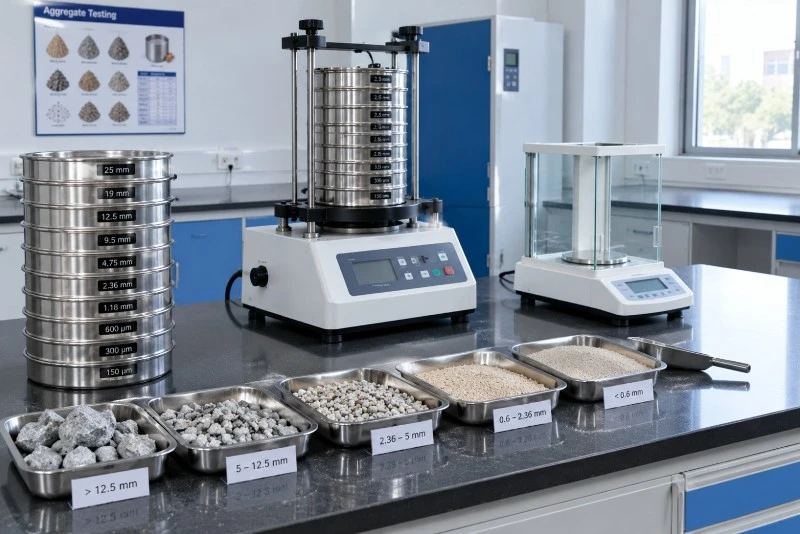
Different aggregate tests measure different material characteristics, so the selected equipment must match the intended method. Clear sample identification and consistent preparation help make results more comparable across batches.
How Do Engineers Choose the Right Aggregate Testing Equipment?
Choosing aggregate testing equipment begins with defining the tests that must be performed and the requirements that govern them. Equipment should not be selected solely by appearance, advertised capacity, or purchase price. Engineers need to confirm that the instrument can accommodate the required aggregate sizes, perform the specified procedure, and produce measurements suitable for the intended evaluation.
Match the Equipment to the Test Method and Aggregate Size
Sieve analysis requires a suitable set of sieves, a reliable weighing arrangement, and appropriate equipment for carrying out the specified procedure. The sieve sizes, sample mass, preparation method, and reporting requirements depend on the test standard and aggregate grading. A sieve set intended for one application may not be sufficient for a different specification.
Mechanical testing equipment has its own configuration requirements. The loading arrangement, specimen grading, sample quantity, operating sequence, and measurement system must be compatible with the specified method. Buyers should check the complete apparatus and required accessories rather than evaluating the main machine in isolation.
Before purchasing, laboratories should identify the exact test methods and editions specified by their clients or quality system. For ASTM methods, the official ASTM International website provides access to standards information. Where European EN standards or national specifications apply, laboratories should confirm the corresponding requirements rather than assume that different procedures are interchangeable.
Evaluate Accuracy, Throughput, and Maintenance
The required measurement range and accuracy should be appropriate for the test. Display resolution alone does not establish measurement accuracy, and a higher-capacity instrument is not automatically more suitable. Buyers should review the manufacturer's stated performance, operating limitations, verification arrangements, and documentation.
Testing throughput is another practical consideration. A laboratory processing many production samples may benefit from equipment that reduces repetitive manual work, provided it still meets the method requirements. A smaller laboratory with occasional testing needs may prioritize simplicity, ease of cleaning, and flexible configuration instead.
Maintenance, spare parts, operator training, and service availability should also be included in the purchasing assessment. Downtime can delay material acceptance and disrupt production schedules, so the total cost of ownership is often more informative than the initial purchase price.
Tianpeng's Rock And Aggregate Testing Equipment category provides a starting point for reviewing relevant testing equipment. The final selection should be checked against the laboratory's actual test scope, required accessories, and applicable specifications. Broader laboratory requirements can also be reviewed through Material Testing Equipment.
How Are Aggregate Test Results Used in Concrete, Asphalt, and Road Construction?
Aggregate test results become valuable when they are connected to material acceptance, mixture design, production control, and investigation of field performance. Engineers should interpret each result in the context of the material's intended use and the other relevant test data.
Material Acceptance and Production Consistency
Material suppliers and contractors use test results to determine whether aggregate deliveries meet the specified requirements. Grading, fines content, density, absorption, particle shape, and mechanical resistance may all contribute to acceptance, depending on the material and application.
A single result should be considered alongside sampling representativeness and production history. If grading changes gradually over several deliveries, the trend may indicate a change in the quarry face, crushing process, screening setup, or stockpile management. Investigating the trend early can prevent a wider production problem.
Mixture Design and Construction Quality Control
For concrete, aggregate grading, moisture, absorption, and density data help establish and adjust mixture proportions. Moisture corrections should reflect the actual condition of the aggregate and the procedure used in the mixture design. If aggregate sources or stockpile conditions change, the design assumptions may need to be reviewed.
For asphalt mixtures, aggregate grading, particle shape, density, and durability contribute to the selection and evaluation of the aggregate blend. These properties must be considered together with binder characteristics, mixture volumetrics, compaction, and the performance requirements of the pavement. Aggregate test results alone cannot predict every aspect of field performance.
In road base and subbase construction, grading and material durability help assess whether the aggregate can be placed and compacted to meet project requirements. Field verification remains necessary because laboratory material properties do not independently establish that the completed layer has achieved the specified construction condition.
Investigating Nonconforming Results and Field Problems
When a result falls outside the acceptance limits, the first step is to verify sample identity, sampling procedure, test method, and calculations. If the result is confirmed, the team should determine whether the issue is isolated or reflects a wider change in material production. Corrective action may involve resampling, adjusting the aggregate blend, changing the production process, or rejecting the affected material, according to the project requirements.
Where a finished concrete or asphalt pavement shows unexpected behavior, aggregate results can help investigate possible causes, but they should not be treated as the only evidence. Concrete cracking, for example, may involve structural loading, curing, shrinkage, or other material factors. Asphalt deformation may relate to binder properties, mixture composition, compaction, temperature, and traffic. A sound investigation compares aggregate data with other relevant material tests and field observations.
For equipment intended for markets where EU product legislation applies, buyers should also check the relevant conformity requirements. The European Commission's CE marking guidance explains when CE marking is required for products covered by applicable EU legislation. CE marking is not a universal certificate of aggregate quality or proof that every test result meets a project specification.
Summary and Recommendations
Aggregate testing provides the evidence needed to assess material suitability for concrete, asphalt mixtures, and road construction. Grading, density, absorption, particle shape, mechanical resistance, and durability each describe a different aspect of aggregate behavior. The correct testing program depends on the intended application, material source, governing specification, and risks that need to be controlled.
For laboratories and construction teams, the most effective approach is to define testing requirements before selecting equipment, use consistent sampling and preparation procedures, and interpret results as part of a broader material-control process. Monitoring trends across deliveries can reveal changes before they lead to widespread nonconformance, while investigating unexpected results systematically helps avoid unsupported conclusions.
The final objective is not simply to produce a collection of test reports. It is to use reliable aggregate data to support material selection, mixture proportioning, production consistency, and construction quality control. When testing methods, equipment, and engineering decisions are aligned, aggregate testing becomes a practical tool for reducing uncertainty and improving the reliability of construction materials.
Frequently Asked Questions (FAQ)
1. What is aggregate testing in construction?
Aggregate testing is the evaluation of properties such as particle-size distribution, density, water absorption, particle shape, mechanical resistance, and durability. The results help determine whether sand, gravel, crushed stone, or other granular materials are suitable for their intended construction application.
2. Which aggregate tests are most important?
The required tests depend on the application and specification. Sieve analysis is widely used to evaluate grading, while density and absorption tests support material calculations. Particle-shape, crushing, abrasion, and durability tests are selected where those properties affect the intended performance.
3. Why does aggregate grading matter?
Grading influences particle packing, void structure, workability, compaction, and mixture proportions. A change in grading can affect the performance and consistency of concrete, asphalt mixtures, and road base materials, even if the aggregate source remains the same.
4. How should a laboratory select aggregate testing equipment?
The laboratory should identify the required methods, aggregate size range, sample requirements, measurement performance, and expected testing volume. It should also consider accessories, maintenance, training, documentation, and technical support before comparing total costs.
5. Can aggregate test results guarantee construction performance?
No. Aggregate tests provide important evidence about material characteristics, but final performance also depends on mixture design, binder or cementitious materials, production, placement, compaction, curing where applicable, environmental exposure, and service loading. Results should be interpreted alongside the other relevant design and quality-control information.
For more product information, technical specifications, or expert consultation on our advanced asphalt testing equipment, please contact our specialist team today at Zhuozhou Tianpeng.