


Understand the Material Before Selecting Testing Equipment
The first step in selecting metal and non-metal testing equipment is identifying the material being evaluated and the properties that need to be measured. Different materials respond differently to mechanical loading, deformation, temperature changes, and external forces. Therefore, the same testing method cannot always be applied to every material.
Metallic materials, including structural steel, reinforcing bars, aluminum alloys, and cast iron, are commonly evaluated for tensile strength, yield strength, elongation, bending performance, and dimensional consistency. These properties help engineers assess whether a material can withstand the mechanical demands of its intended application.
Non-metallic materials cover a much broader range, including plastics, rubber, ceramics, glass, and composite materials. Their testing requirements may involve tensile behavior, compression resistance, flexural strength, deformation, and dimensional stability.
|
Material Type |
Important Properties |
Typical Testing Requirements |
|
Structural steel |
Yield strength, tensile strength, elongation |
Tensile and bending tests |
|
Reinforcing steel |
Ductility, bending performance |
Rebar bending tests |
|
Aluminum alloys |
Tensile strength, deformation |
Tensile and dimensional tests |
|
Plastics |
Tensile strength, elongation, flexural behavior |
Tensile and flexural tests |
|
Rubber |
Elasticity, elongation, deformation |
Tensile and extension tests |
|
Glass and ceramics |
Thickness, dimensional consistency, brittleness |
Thickness and mechanical evaluation |
|
Composite materials |
Tensile, compression, interlaminar behavior |
Specialized mechanical tests |
Understanding these differences helps engineers narrow down suitable metal and non-metal testing equipment before comparing individual models.
Different material types require different testing methods, specimen preparation procedures, and measurement configurations.
Match Testing Equipment to the Required Mechanical Properties
After identifying the material, engineers should determine exactly which properties need to be evaluated. This is one of the most important decisions when purchasing metal and non-metal testing equipment.
Tensile and Compression Testing for Mechanical Performance
Tensile testing is widely used to determine how materials behave under pulling forces. Engineers can evaluate tensile strength, yield strength, elongation, and other mechanical characteristics depending on the testing procedure and measurement configuration.
Compression testing, in contrast, examines material behavior under compressive loads. It is particularly relevant to structural components, rigid plastics, and materials designed to withstand pressure.
Universal Testing Machines are suitable for laboratories that need to perform multiple mechanical testing procedures using interchangeable fixtures and accessories. Depending on the configuration, these machines can support tensile, compression, flexural, shear, and peel testing.
Tianpeng provides several Universal Testing Machine configurations, including WDW-M, WDW-H, WAWD, WAW, and WEW series. Engineers should select the appropriate model according to the maximum expected force, specimen dimensions, required test modes, and measurement range.
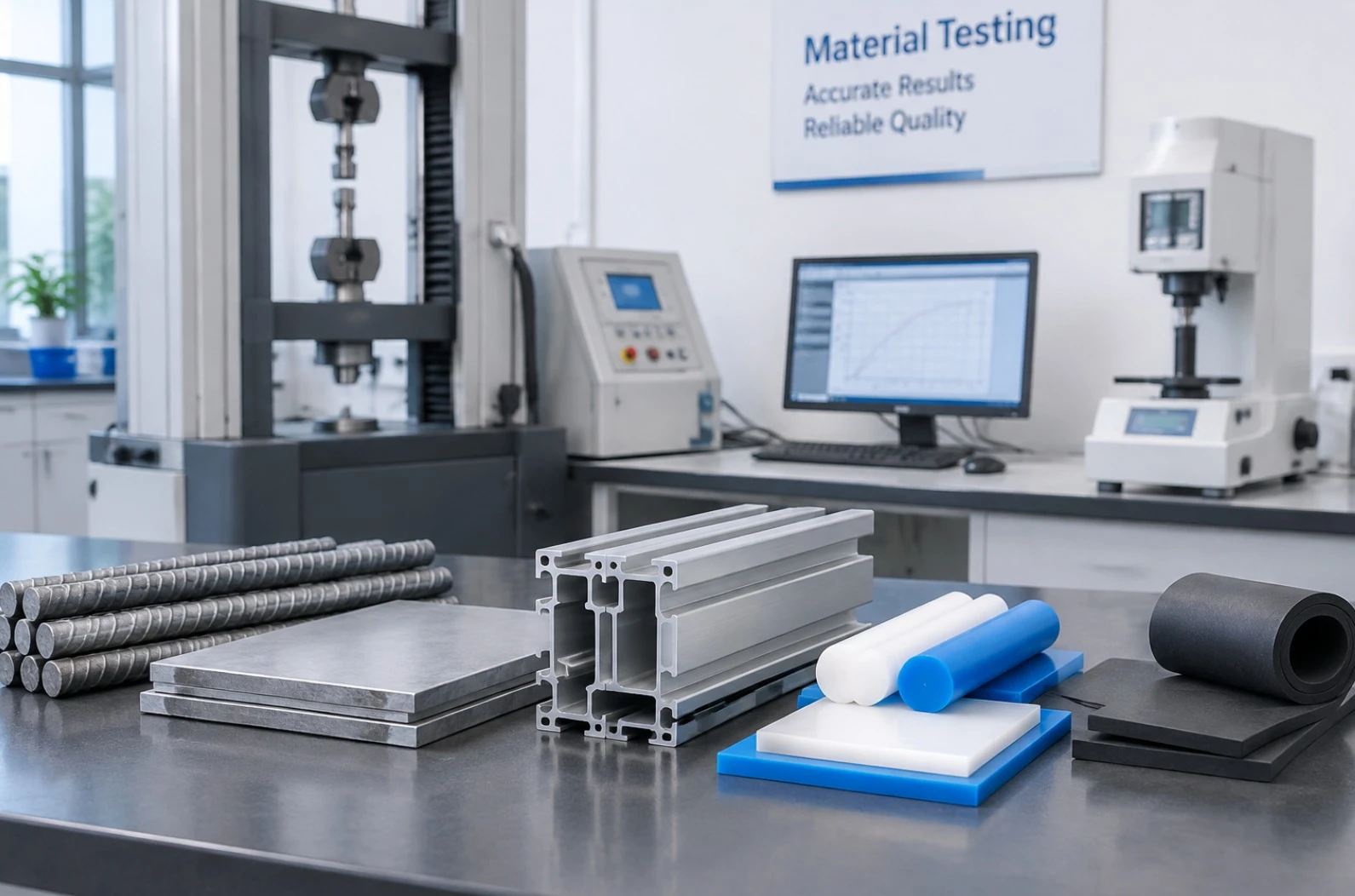
Universal Testing Machines provide flexible mechanical testing configurations for different metallic and non-metallic specimens.
Bending Tests for Reinforcing Steel and Metal Components
Tensile strength alone cannot fully describe how reinforcing steel performs during construction. Steel bars may undergo bending during fabrication and installation, making bending performance an important quality-control consideration.
A Rebar Bend Testing Machine is designed for evaluating the bending behavior of reinforcing bars under specified test conditions. Engineers should consider the applicable bar diameter range, bending angle, mandrel dimensions, specimen positioning, and machine capacity.
The selected equipment must accommodate the actual dimensions and testing procedures used by the laboratory. Incorrect mandrel dimensions or unsuitable bending configurations may affect the validity of the test results.
Thickness Measurement for Metal and Non-Metal Materials
Thickness measurement is another important part of material inspection, particularly when examining pipes, plates, manufactured components, and products with defined wall-thickness requirements.
Tianpeng's Digital Ultrasonic Thickness Tester, available in the Leeb320, Leeb321, and Leeb322 models, is designed for measuring metallic materials such as steel, cast iron, and aluminum, as well as suitable non-metallic materials including plastics, ceramics, and glass.
The published measuring range is 0.7–300 mm, depending on the probe and material. The Leeb322 model offers a resolution of 0.01 mm, while the other two models offer 0.1 mm resolution.
However, ultrasonic thickness measurement depends on acoustic transmission, material properties, surface conditions, and suitable probe selection. Engineers should verify that the material and specimen geometry are compatible with the selected instrument.

Portable ultrasonic thickness measurement equipment helps engineers inspect material dimensions without cutting or sectioning suitable specimens.
Evaluate Measurement Range, Accuracy, and Specimen Dimensions
One common purchasing mistake is selecting equipment based only on its maximum capacity. A machine with a very high rated force is not automatically suitable for every testing application.
For example, a laboratory testing thin plastic specimens may require a relatively low-capacity load cell and sensitive deformation measurement. Testing structural steel specimens, however, may require higher loading capacity, stronger grips, and suitable extensometers.
Engineers should calculate the expected maximum testing force before selecting a universal testing machine.
For tensile testing, the estimated force can be calculated using:
F = R × A
Where F is the expected force, R is the expected tensile strength, and A is the original specimen cross-sectional area.
The selected machine should have sufficient capacity above the expected maximum load while maintaining the required measurement accuracy within its working range.
|
Selection Parameter |
What Engineers Should Check |
Why It Matters |
|
Force capacity |
Expected maximum test load |
Prevents overload and unsuitable measurement ranges |
|
Measurement accuracy |
Accuracy across the working range |
Supports reliable test results |
|
Specimen dimensions |
Length, width, thickness, and diameter |
Determines fixture compatibility |
|
Loading speed |
Required test speed or strain rate |
Ensures compliance with test procedures |
|
Deformation measurement |
Extensometer or displacement measurement |
Improves strain and elongation evaluation |
|
Fixtures |
Grips, bending supports, and compression plates |
Ensures proper specimen loading |
Why Calibration and Measurement Traceability Matter
Equipment accuracy should be evaluated using documented verification and calibration information rather than relying solely on the manufacturer's advertised precision.
For universal testing machines, engineers should review force verification, load-cell calibration, displacement measurement, and extensometer performance where applicable. ISO 7500-1 provides a framework for verification and calibration of static uniaxial testing machines.
A machine may display many decimal places without necessarily delivering corresponding measurement accuracy. What matters is its verified performance over the range in which the laboratory actually operates.
Consider Testing Standards and Laboratory Requirements
Applicable testing standards should be identified before equipment procurement. ASTM, ISO, and EN standards may specify different specimen dimensions, loading rates, conditioning procedures, and reporting requirements.
The following are examples of standards commonly encountered in metal and non-metal material testing:
|
Standard |
Testing Application |
|
ASTM E8/E8M |
Tension testing of metallic materials |
|
ISO 6892-1 |
Tensile testing of metallic materials at room temperature |
|
ASTM D638 |
Tensile properties of plastics |
|
ISO 527 |
Tensile properties of plastics |
|
ASTM A615/A615M |
Deformed and plain carbon-steel bars for concrete reinforcement |
|
ISO 15630-1 |
Testing of reinforcing steel for concrete |
Engineers should always verify the current edition and exact scope of the standard before specifying the equipment. A machine's general testing capability does not automatically establish compliance with every test method.
Review Electrical, Environmental, and Installation Conditions
Laboratory conditions are equally important. Before purchasing metal and non-metal testing equipment, engineers should confirm available power supply, floor space, equipment dimensions, ventilation, and operating temperature.
Large testing machines may require reinforced foundations and dedicated electrical connections. Smaller instruments may offer greater flexibility but still require suitable calibration conditions and careful specimen preparation.
For laboratories performing different types of testing, it is also useful to consider equipment maintenance, operator training, spare parts availability, and the accessibility of technical documentation.
Check Product Documentation, Safety, and Supplier Support
A reliable equipment supplier should provide more than a quotation and product photograph. Engineers should request detailed specifications, operating instructions, configuration lists, calibration information, and relevant conformity documentation.
CE marking is particularly relevant when equipment is intended for markets where applicable European Union legislation requires it. However, CE marking is not a universal quality or testing-performance certificate. Its applicability depends on the product and the relevant EU legislation.
Before purchasing, buyers can review the manufacturer's available documentation and consult the European Commission's official CE Marking Guidance. Tianpeng also provides examples of product-specific CE documentation in its company certification and qualification section.
Engineers should check whether the documentation applies to the exact equipment model being purchased rather than assuming that one certificate covers an entire product range.
Supplier support also matters throughout the equipment lifecycle. Technical consultation, installation guidance, operating training, calibration assistance, and spare parts availability can significantly influence long-term laboratory efficiency.
Summary and Recommendations for Choosing the Right Equipment
Choosing suitable metal and non-metal testing equipment is a technical decision that should begin with the material and testing objective, not the equipment catalogue.
Engineers should first identify the required material properties, determine the applicable testing standards, and establish the necessary measurement range. They should then evaluate specimen dimensions, fixture compatibility, calibration requirements, installation conditions, and supplier support.
For laboratories handling different materials, a combination of versatile universal testing machines and application-specific instruments may provide a more practical configuration than purchasing several machines with overlapping functions.
Tianpeng offers testing solutions across multiple categories, including Universal Testing Machines, Material Testing Equipment, and General Equipment, supporting different laboratory and industrial testing requirements.
Other relevant product categories include Concrete Testing Equipment, Cement Testing Equipment, Rock and Aggregate Testing Equipment, Asphalt Testing Equipment, and Soil Testing Equipment.
The most suitable solution is ultimately the one that meets the laboratory's actual testing requirements, produces dependable results, and remains practical to operate and maintain over the long term.
Frequently Asked Questions About Metal and Non-Metal Testing Equipment
1. What factors should engineers consider when purchasing material testing equipment?
Engineers should consider material type, testing purpose, required measurement range, accuracy, specimen dimensions, applicable standards, available fixtures, calibration requirements, and installation conditions.
2. Can one universal testing machine test both metal and non-metal materials?
Yes. A properly configured universal testing machine can test different materials, including metals, plastics, rubber, and composites. However, suitable load cells, grips, fixtures, and deformation measurement devices must be selected for each application.
3. What is the difference between tensile testing and bending testing?
Tensile testing evaluates material behavior under axial pulling forces, while bending testing examines resistance to deformation under bending loads. They provide different mechanical properties and should not be treated as interchangeable methods.
4. How important is calibration when selecting testing equipment?
Calibration is essential because it helps verify measurement accuracy and traceability. Laboratories should review calibration documentation, measurement ranges, and relevant verification requirements before using equipment for quality-control or research purposes.
5. How can laboratories choose equipment for multiple material testing applications?
Laboratories should identify their most frequently performed tests and prioritize equipment with suitable measurement ranges and interchangeable fixtures. Combining versatile universal testing machines with specialized instruments can help reduce unnecessary equipment investment while maintaining testing capability.
For more product information, technical specifications, or expert consultation on our advanced asphalt testing equipment, please contact our specialist team today at Zhuozhou Tianpeng.