


What Causes Concrete Shrinkage and Why Does It Matter?
Concrete does not remain dimensionally stable after casting. As cement hydrates and moisture moves through the material, the concrete volume can change. The amount and timing of this movement depend on the water-to-cementitious-material ratio, cement composition, aggregate properties, member dimensions, ambient conditions, and curing practices.
The engineering concern is not simply that concrete becomes shorter. Shrinkage becomes a structural problem when the movement is restrained. For example, a concrete floor may be restrained by columns, walls, or an existing substrate. A reinforced concrete wall may experience restraint from its foundation and reinforcement. When the concrete attempts to contract but cannot move freely, tensile stress develops. If this stress exceeds the tensile capacity of the concrete at that age, cracking may occur.
Cracks can affect more than appearance. Depending on their width, depth, location, and exposure conditions, they may provide pathways for water and aggressive substances, reduce watertightness, and increase maintenance requirements. This is why concrete shrinkage testing is relevant to structural serviceability and durability, not just laboratory material characterization.
The Main Types of Concrete Shrinkage
Different shrinkage mechanisms occur at different stages and under different environmental conditions. Engineers should identify the mechanism relevant to the structure before selecting a test method.
|
Shrinkage type |
Main cause |
Typical engineering concern |
|
Plastic shrinkage |
Rapid evaporation of surface water before concrete sets |
Early surface cracking in slabs and exposed surfaces |
|
Drying shrinkage |
Moisture loss from hardened concrete to the surrounding environment |
Long-term shortening and restrained cracking |
|
Autogenous shrinkage |
Self-desiccation associated with cement hydration, particularly in low water-to-binder mixtures |
Internal tensile stress in dense, low-permeability concrete |
|
Thermal contraction |
Cooling after heat generated during hydration or exposure to temperature changes |
Cracking in mass concrete and restrained members |
|
Carbonation shrinkage |
Chemical reaction between carbon dioxide and cement hydration products |
Additional dimensional change near exposed surfaces |
These mechanisms should not be treated as interchangeable. A drying shrinkage test, for example, does not automatically represent the early-age behavior of a thick concrete wall or the autogenous shrinkage of a low water-to-binder mixture.
Why Shrinkage Is a Structural Engineering Issue
In a freely moving laboratory specimen, shrinkage can be measured as a change in length. In a real structure, however, the concrete is connected to other materials and structural components. Reinforcement, foundations, older concrete, and changes in member thickness can all restrain movement.
The resulting tensile stress depends on the degree of restraint, the rate of shrinkage, the tensile strength development, and the creep behavior of the concrete. Two mixtures with similar measured shrinkage may therefore develop different cracking behavior in different structural configurations.
For this reason, shrinkage measurements should be interpreted alongside structural detailing, curing conditions, concrete age, and the expected exposure environment.
How Does Concrete Shrinkage Testing Help Prevent Structural Cracking?
The primary value of concrete shrinkage testing is that it provides measurable evidence of dimensional change before the material is used in a project. Instead of relying only on general assumptions about a mixture, engineers can compare candidate mixtures under controlled conditions and observe how their length changes over time.
This is particularly useful when a project involves large floor slabs, long retaining walls, bridge decks, water-retaining structures, or other members where restraint and cracking control are important.
Comparing Different Concrete Mixtures Before Construction
A laboratory can prepare specimens using different cementitious materials, aggregate combinations, admixture dosages, or water-to-binder ratios. By keeping specimen dimensions, curing conditions, and measurement schedules consistent, the laboratory can compare the dimensional behavior of each mixture.
The results can help engineers identify whether a proposed mixture produces unusually high shrinkage under the selected test conditions. If one mixture shows greater length change, the team can investigate its binder content, aggregate stiffness, paste volume, water demand, and curing sensitivity before approving the mix for construction.
Evaluating the Effect of Curing and Environmental Conditions
Curing has a direct influence on moisture loss and early-age concrete behavior. Inadequate curing can accelerate surface drying, particularly in hot, windy, or low-humidity conditions. This may increase the risk of plastic shrinkage cracking and can also affect subsequent drying behavior.
A useful laboratory program should therefore document the curing procedure, temperature, relative humidity, and the age at which specimens are transferred to the measurement environment. Without this information, shrinkage results from different batches or laboratories may not be directly comparable.

Shrinkage-related cracking is influenced by restraint, member geometry, environmental exposure, and curing quality. Observing these conditions helps engineers connect laboratory measurements with actual construction risks.
Which Methods Are Used for Measuring Concrete Shrinkage?
The appropriate measurement method depends on the type of shrinkage being investigated. Some tests measure the length change of hardened concrete specimens over time, while others evaluate restrained expansion or shrinkage under defined conditions. A laboratory should select the method according to the project specification and the behavior that needs to be assessed.
Measuring Length Change in Concrete Specimens
Length-change measurement is a practical approach for monitoring dimensional movement over a defined period. A specimen is prepared with a specified geometry, conditioned according to the selected procedure, and measured at defined ages. The difference between the initial and subsequent readings indicates the change in specimen length.
The result is commonly expressed as a length change relative to the original gauge length. This allows specimens of the same test series to be compared and helps engineers observe whether shrinkage is progressing rapidly or approaching a more stable condition.
For reliable results, specimen dimensions, reference points, temperature, moisture exposure, and measurement timing must be controlled. The measurement instrument should also have suitable resolution and repeatability for the expected movement.
Restrained Shrinkage and Expansion Measurement
Free shrinkage measurements show how a specimen changes length when it is allowed to move. However, structural concrete is often restrained. A restrained test can therefore provide additional information about the dimensional behavior of concrete under a defined restraint condition.
Tianpeng's TPSE-400 Shrinkage and Expansion Apparatus is designed to measure the axial restrained expansion rate and axial restrained dry shrinkage rate of compensating concrete specimens during hardening under specified environmental conditions.
The product is intended for a specimen size of 100 × 100 × 400 mm. Its listed measuring range is 350–360 mm, with a standard rod length of 355 mm ± 0.02 mm and a dial gauge range of 0–10 mm with a stated resolution of 0.001 mm.
These characteristics make the apparatus relevant to laboratories investigating restrained dimensional changes in compensating concrete. The test results should still be interpreted according to the applicable procedure and should not be assumed to represent every structural restraint condition.
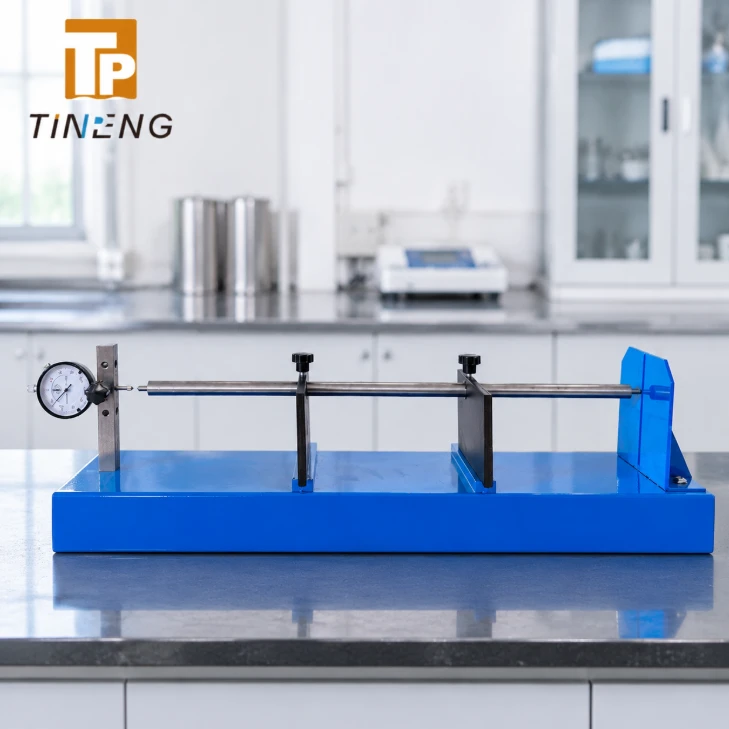
The TPSE-400 is designed for measuring restrained expansion and restrained drying shrinkage in compensating concrete specimens. Its measurement range and specimen dimensions should be checked against the laboratory's selected test procedure.
Using a Length Comparator for Dimensional Monitoring
A length comparator is another important instrument for measuring changes in the length of cement and concrete specimens. It typically uses a rigid frame and a dial indicator or digital gauge to compare the specimen length with a reference measurement.
Tianpeng's Measurement of Length Changes product category includes length comparator equipment for cement and concrete specimens. The product information describes applications involving 40 × 40 × 160 mm specimens and other specimen sizes, with an adjustable upper anvil to accommodate the required testing length.
A length comparator is particularly useful when the laboratory needs repeated measurements over a test period. However, the instrument alone does not define the test method. The reference points, specimen preparation, conditioning, and measurement schedule must follow the selected standard.
What Factors Can Affect Concrete Shrinkage Test Results?
A shrinkage result is only useful when the testing conditions are properly controlled. Differences in specimen preparation or environmental exposure can create variation that is mistakenly attributed to the concrete mixture.
Specimen Geometry and Aggregate Characteristics
Specimen size affects the rate at which moisture moves through concrete. Smaller specimens generally have a higher surface-area-to-volume ratio and may lose moisture more rapidly than large structural members. This means laboratory results should not be transferred directly to full-scale structures without considering the difference in geometry.
Aggregate properties are also important. Aggregates provide internal restraint against the contraction of cement paste. Their stiffness, grading, volume fraction, and moisture condition can influence the overall shrinkage of concrete. A mixture with a high paste volume may behave differently from one with a well-graded aggregate skeleton, even if both meet the same compressive-strength requirement.
Temperature, Relative Humidity, and Curing History
Temperature and relative humidity influence moisture movement and hydration. A specimen exposed to low relative humidity may experience faster drying than one stored in a controlled environment. Temperature variations can also affect measured length and introduce errors if the instrument and specimen are not allowed to reach stable conditions.
For this reason, laboratories should record environmental conditions throughout the test. Specimens should be handled consistently, and measurements should be performed at comparable temperatures whenever the procedure requires it.
|
Factor |
Potential influence on results |
Practical control |
|
Specimen dimensions |
Changes drying rate and moisture distribution |
Use specified moulds and dimensions |
|
Aggregate grading |
Influences paste volume and internal restraint |
Maintain consistent aggregate sources and grading |
|
Water-to-binder ratio |
Affects capillary structure and moisture loss |
Record actual batch proportions |
|
Curing conditions |
Changes early moisture loss and hydration |
Apply a consistent curing procedure |
|
Relative humidity |
Influences drying shrinkage rate |
Monitor and record test-room conditions |
|
Measurement temperature |
Can affect specimen and instrument dimensions |
Stabilize conditions before readings |
Which Standards Should Be Considered for Concrete Shrinkage Testing?
The test standard should be selected according to the type of dimensional change being investigated. For example, ASTM C157/C157M covers length change of hardened hydraulic-cement mortar and concrete. It is relevant when evaluating length change under the specified specimen preparation and storage conditions.
For restrained shrinkage cracking, ASTM C1581/C1581M addresses age at cracking and induced tensile stress characteristics of mortar and concrete under restrained conditions. It investigates a different aspect of shrinkage behavior from a free length-change measurement.
These methods should not be treated as interchangeable. A laboratory must confirm the current edition, specimen requirements, conditioning procedure, measurement intervals, and reporting rules before conducting the test. The equipment configuration must be suitable for the selected method.
Distinguishing Test Standards from CE Marking
ASTM and EN standards describe technical test methods or product requirements, depending on their scope. CE marking is different: it is a conformity marking under applicable European Union legislation. It does not certify that a testing instrument can automatically perform every concrete shrinkage test.
When purchasing laboratory equipment for the European market, users should review the applicable requirements and manufacturer documentation. The European Commission provides official information on CE marking, including the manufacturer's responsibilities for conformity assessment and the relevant declaration.
How Should Engineers Use Shrinkage Test Results in Structural Design?
A shrinkage value should not be treated as a direct prediction of crack width or the exact time when a structural member will crack. Instead, it is one input for assessing material behavior and comparing design options.
Engineers should first identify the likely shrinkage mechanism and the structural elements that restrain movement. They can then compare laboratory results with the proposed member dimensions, reinforcement arrangement, construction sequence, joint spacing, and expected environmental conditions.
If the results indicate a high shrinkage tendency, the design and construction team can review practical measures such as reducing unnecessary paste volume, optimizing aggregate grading, reviewing water demand, improving curing protection, and planning appropriate joints. For thick or highly restrained members, thermal effects and early-age behavior may also require separate evaluation.
The most useful approach is to connect laboratory evidence with construction planning. A shrinkage test does not replace structural analysis, but it provides information that can make material selection and crack-control decisions more informed.
Summary and Recommendations
Concrete shrinkage testing is important because dimensional change can generate tensile stress when movement is restrained by reinforcement, foundations, adjacent concrete, or structural geometry. If the resulting stress exceeds the concrete's tensile capacity, cracking may develop and affect serviceability, watertightness, and long-term durability.
For practical engineering work, laboratories should select a test method that matches the shrinkage mechanism being investigated. Length-change measurements are useful for monitoring dimensional movement, while restrained shrinkage and expansion testing can provide information about compensating concrete under defined restraint conditions.
Tianpeng's TPSE-400 Shrinkage and Expansion Apparatus and its length comparator range provide equipment options for these measurement applications. The final equipment selection should be based on specimen dimensions, measurement range, required resolution, and the applicable test procedure.
The most important recommendation is to interpret shrinkage results in context. Mixture design, curing, environmental conditions, structural restraint, and construction sequence all influence cracking risk. Combining controlled laboratory testing with appropriate structural detailing and site practices provides a more reliable approach to shrinkage-related crack control.
Frequently Asked Questions About Concrete Shrinkage Testing
FAQ 1: What is the main purpose of concrete shrinkage testing?
The main purpose is to measure dimensional change over time and evaluate the potential for shrinkage-related cracking. The results help engineers compare concrete mixtures and assess material behavior under defined laboratory conditions.
FAQ 2: What is the difference between drying shrinkage and autogenous shrinkage?
Drying shrinkage is mainly associated with moisture loss from hardened concrete to the surrounding environment. Autogenous shrinkage is associated with internal moisture consumption and self-desiccation during hydration, and can be significant in low water-to-binder mixtures.
FAQ 3: Does higher concrete shrinkage always mean more structural cracks?
Not necessarily. Cracking also depends on restraint, tensile strength development, creep, member dimensions, reinforcement, temperature, and curing. Shrinkage measurements indicate dimensional behavior, but they do not independently predict the number or width of cracks.
FAQ 4: What equipment is used for concrete shrinkage measurement?
The equipment depends on the test method. A length comparator can measure changes in specimen length, while the TPSE-400 Shrinkage and Expansion Apparatus is designed to measure axial restrained expansion and axial restrained dry shrinkage in compensating concrete specimens.
FAQ 5: How can engineers reduce shrinkage-related cracking?
Engineers can review mixture proportions, reduce unnecessary paste and water demand, optimize aggregate grading, apply effective curing, consider member geometry and restraint, and plan suitable joints and reinforcement details. The appropriate measures depend on the concrete type and structural conditions.
For more product information, technical specifications, or expert consultation on our advanced asphalt testing equipment, please contact our specialist team today at Zhuozhou Tianpeng.