


Selecting aggregate testing equipment is an important part of establishing a reliable construction materials laboratory. Aggregates are used in concrete, asphalt mixtures, pavement structures, railway construction, and other infrastructure applications. Their properties influence mixture workability, mechanical performance, durability, and long-term service behaviour. However, different projects require different testing programmes, so a laboratory does not necessarily need every type of aggregate testing machine.
A common purchasing mistake is to select equipment based mainly on price, appearance, or a supplier's general product list. A machine may appear suitable but still fail to meet the required test method because its dimensions, accessories, operating range, or control arrangement are different from those specified in the standard. Engineers should therefore work backwards from the test requirements and identify the equipment configuration that can produce valid and repeatable results.
Identify the Required Aggregate Tests Before Selecting Equipment
The first step is to define what the laboratory needs to measure. Aggregate testing equipment should be selected according to the properties that matter to the intended application, rather than purchased as a general-purpose collection of instruments.
Match Equipment to the Intended Construction Application
A laboratory supporting concrete production may need to investigate fine aggregate characteristics that influence water demand, workability, and mixture stability. An asphalt laboratory may place greater emphasis on fine aggregate angularity and the effect of particle shape and surface texture on mixture performance. A laboratory serving concrete durability investigations may also need equipment for evaluating the potential expansion associated with alkali-aggregate reactions.
The testing programme should reflect the material's role in the finished construction. For example, fine aggregate angularity can influence the behaviour of the mortar or asphalt mastic surrounding coarse particles. In asphalt mixtures, the characteristics of the fine aggregate contribute to internal friction and mixture stability. In concrete, particle shape and surface texture can influence water demand and workability.
A useful starting point is to prepare a test-requirement matrix before requesting quotations.
|
Laboratory application |
Testing objective |
Equipment considerations |
|
Asphalt mixture design |
Evaluate fine aggregate angularity and particle characteristics |
Fine aggregate angularity apparatus and specified measuring accessories |
|
Concrete durability assessment |
Investigate potential alkali-aggregate expansion |
Alkali-aggregate testing equipment and controlled environmental conditions |
|
Aggregate source evaluation |
Prepare representative samples for different test procedures |
Suitable sample preparation equipment and documented procedures |
|
Research and material development |
Compare aggregate characteristics under defined methods |
Equipment compatibility, repeatability, and result documentation |
This matrix should be expanded using the actual project specification. A laboratory testing aggregates for a highway authority may have different requirements from a university research laboratory or a ready-mixed concrete producer.
Distinguish Essential Tests from Occasional Tests
Not every laboratory performs every test daily. Some instruments are required for routine production control, while others may be used only for material qualification, research, or investigations into unusual performance problems.
For frequently performed tests, equipment capacity, operating convenience, and repeatability become important purchasing considerations. For occasional tests, it may be more economical to consider whether the equipment will be used often enough to justify its purchase, maintenance, and calibration costs.
Engineers should also consider whether a test is required by contract, regulation, or an internal quality-control programme. This helps prevent the purchase of equipment that has little practical value to the laboratory's actual workload.
Check Standard Compatibility and Technical Specifications
Once the required tests are identified, the next step is to confirm that the proposed equipment can perform the relevant test method. A product description that simply states "for aggregate testing" is not sufficient. The standard number, test procedure, specimen requirements, and equipment configuration must all be checked.
Confirm the Applicable Standard and Its Current Edition
Different standards may use different sample preparation procedures, apparatus dimensions, operating conditions, and calculation methods. Even when two methods evaluate a similar aggregate property, their equipment requirements may not be identical.
For example, ASTM C1252 covers the determination of uncompacted void content of fine aggregate as influenced by particle shape, surface texture, and grading. The method provides an indication of fine aggregate angularity and related characteristics under standardized conditions. A laboratory intending to perform this test should check that the apparatus configuration and accessories correspond to the selected method.
Tianpeng's Fine/Coarse Aggregate Angularity Apparatus, models H-1680A and H-1686, is listed for relevant fine and coarse aggregate angularity applications. The H-1680A is specified for fine aggregate testing under ASTM C1252 and AASHTO methods, while H-1686 is listed for the AASHTO TP56 application. These configurations should not be treated as interchangeable: the laboratory must select the version that matches its required procedure.
Fine aggregate angularity apparatus is used to determine uncompacted void content under specified test conditions. The correct model and accessories should be selected according to the applicable method.
Compare the Full Technical Configuration, Not Just the Product Name
Before purchasing, engineers should compare the actual equipment configuration with the test procedure. Important details may include the dimensions and material of the measuring components, sample capacity, operating range, temperature stability, control functions, and required accessories.
For example, an apparatus may be described as suitable for angularity testing, but the laboratory still needs to verify the measuring-cylinder volume, funnel arrangement, sample quantity, and calibration requirements. A difference in one of these details may affect the suitability of the apparatus for a particular standard.
A technical comparison sheet can help purchasing teams evaluate suppliers consistently.
|
Specification to verify |
Why it matters |
|
Applicable test standards |
Confirms whether the apparatus supports the required method |
|
Sample size and capacity |
Prevents incompatibility with the laboratory's sample preparation procedure |
|
Measuring component dimensions |
Helps ensure the specified test geometry is maintained |
|
Operating range and control accuracy |
Important for equipment involving controlled temperature or time |
|
Included accessories |
Identifies additional items that may need to be purchased |
|
Power supply and installation conditions |
Avoids problems during delivery and commissioning |
|
Manuals and technical documentation |
Supports correct operation, maintenance, and traceability |
Evaluate Sample Preparation and Laboratory Workflow
Equipment performance is only one part of reliable testing. Poor sample preparation can introduce errors before a sample is even placed in the testing apparatus. Engineers should therefore assess the complete workflow, including sample receipt, identification, preparation, conditioning, testing, and result recording.
Consider How Aggregate Samples Are Prepared
Aggregate samples may arrive from quarries, crushing plants, concrete producers, asphalt plants, or construction sites. They can differ in particle size, moisture condition, grading, and the amount of material available. The laboratory needs a controlled procedure to obtain representative test portions.
Sample preparation should avoid unintended changes to the material. Excessive crushing, contamination from previous samples, loss of fine particles, or inconsistent splitting can affect the representativeness of the test portion. Equipment used for sample preparation should therefore be selected according to the materials handled and the procedures required by the laboratory.
Tianpeng's rock and aggregate equipment range includes sample-preparation products such as Riffle Boxes (Sample Dividers). A sample divider can support the preparation of representative portions when used with an appropriate procedure. Its capacity and slot arrangement should be suitable for the material's particle size and the required sample quantity.
Plan the Laboratory Layout and Operating Sequence
The physical arrangement of equipment affects both efficiency and test quality. Sample receiving and storage areas should be separated from clean measuring areas where practical. Equipment that produces dust, vibration, or noise may require a suitable location away from sensitive measurement activities.
A well-planned workflow also reduces unnecessary sample movement. For example, sample identification and preparation should be completed before testing begins, and test records should be linked to the sample identification number. This makes it easier to trace an unusual result back to its original material source and preparation history.
For laboratories handling several aggregate types, it is useful to establish separate storage locations for different sources and size fractions. Clear labelling helps prevent the accidental mixing of samples, which can invalidate comparisons between suppliers or production batches.
Select Equipment According to Test Frequency, Accuracy, and Operating Conditions
The next consideration is how often the equipment will be used and how consistently it must operate. A laboratory conducting a few qualification tests each month has different requirements from a commercial testing centre processing multiple samples every day.
Match Equipment Capacity to the Expected Workload
Equipment capacity should be assessed against the expected number of tests, sample quantities, and time required for each procedure. A machine with a larger capacity is not automatically the best choice. If the laboratory rarely uses the additional capacity, the higher purchase cost and larger installation footprint may not be justified.
For equipment used in routine testing, consider the full operating cycle rather than only the time required for the main test. Sample preparation, loading, cleaning, conditioning, and documentation can all contribute to the time needed to complete a test. These activities may become the actual bottleneck in a busy laboratory.
Check Temperature Control and Environmental Stability
Some aggregate-related investigations require controlled temperature and time conditions. Alkali-aggregate reaction testing is one example. The test programme may involve conditioning aggregate or mortar specimens under specified environmental conditions, so the laboratory must ensure that the equipment can maintain the required operating environment.
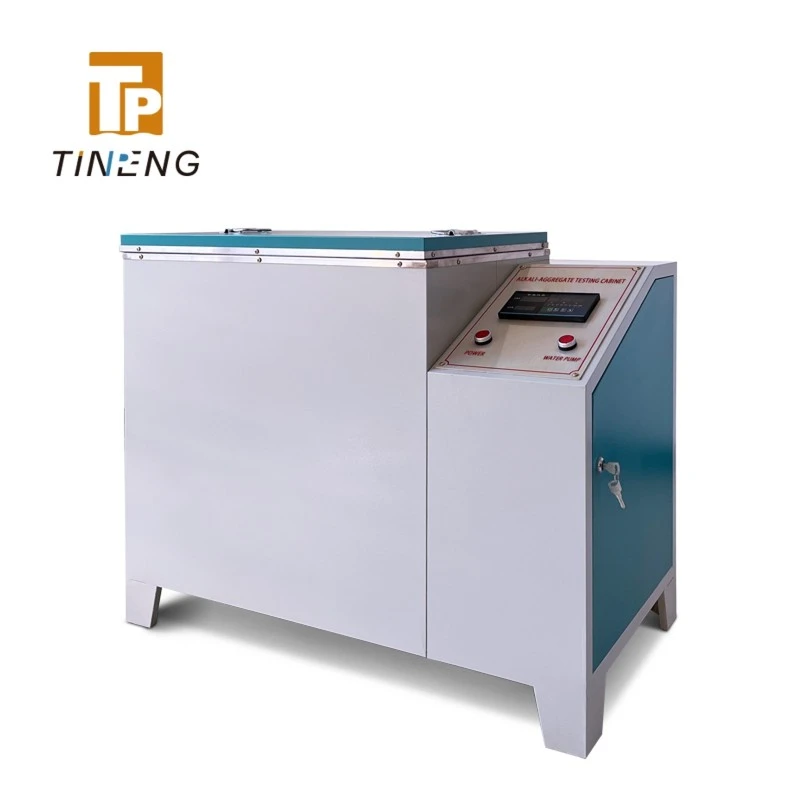
Tianpeng offers the JHX-1 Alkali-Aggregate Testing Cabinet, which is designed for temperature and time control in sand and gravel aggregate expansion detection. Its published technical parameters include a temperature of 80°C ± 0.5°C, a 220 V power supply, and a 4000 W heating power. The cabinet's capacity is listed as 600 × 400 × 450 mm.
The relevant test method must still be checked carefully. For example, ASTM C1260 addresses the potential alkali reactivity of aggregates using the mortar-bar method, while ASTM C1567 evaluates combinations of cementitious materials and aggregate using an accelerated mortar-bar method. These methods have distinct specimen and procedure requirements. A temperature-controlled cabinet alone does not constitute a complete alkali-silica reactivity testing system.
Consider Calibration, Verification, and Maintenance
Reliable results require more than buying equipment with an appropriate specification. Laboratories should establish a maintenance and verification schedule based on the equipment type, frequency of use, manufacturer instructions, and applicable quality-management requirements.
Before commissioning, check the condition of the equipment, the completeness of its accessories, and whether the supplied documentation matches the purchased configuration. For equipment involving temperature control, verify that the temperature distribution and stability are suitable for the intended procedure. For measuring apparatus, check dimensions and relevant measurement references.
A laboratory should also maintain records of equipment identification, installation, inspection, maintenance, calibration or verification where applicable, and any repairs. These records help demonstrate that the equipment was maintained in a suitable condition when test results were produced.
Compare Suppliers, Safety Features, and Total Cost of Ownership
Price is an important factor, but the lowest initial quotation does not necessarily represent the lowest long-term cost. Engineers should consider whether the supplier can provide the correct configuration, technical documentation, operating guidance, spare parts, and after-sales support.
Review Safety and Compliance Documentation
Aggregate testing equipment may involve moving components, heated environments, electrical systems, or heavy samples. The laboratory should review relevant protective arrangements, operating instructions, electrical requirements, and maintenance procedures before installation.
Where equipment is supplied to the European market, CE marking should be considered according to the applicable product legislation. The European Commission's CE marking guidance explains that CE marking is required only for product categories covered by relevant EU legislation. It is not a general quality certificate, and it does not automatically apply to every laboratory instrument.
Buyers should ask suppliers for the applicable declaration of conformity and supporting technical documentation when CE legislation applies to the product. They should not assume that a CE logo alone demonstrates compliance with a particular aggregate test standard.
Calculate the Total Cost of Ownership
The purchase price is only one part of the equipment cost. Installation, accessories, consumables, maintenance, calibration, energy consumption, spare parts, and operator training can all affect the long-term budget.
A practical supplier comparison should therefore include the complete configuration and service requirements. If an accessory is essential to perform the specified test but is not included in the quotation, the apparent price advantage may disappear once the full system is assembled.
Tianpeng provides a range of Rock and Aggregate Testing Equipment for laboratory and construction-material testing applications. When comparing equipment, customers should provide the required standard, sample range, and intended test frequency so that the proposed configuration can be checked against the actual application.
Summary and Recommendations
Choosing the right aggregate testing equipment requires a clear understanding of the laboratory's testing objectives, applicable standards, sample characteristics, and expected workload. Engineers should begin by identifying the tests required for concrete, asphalt, road materials, or research applications. They should then verify that the proposed equipment matches the relevant method in terms of configuration, dimensions, operating conditions, and accessories.
Sample preparation, laboratory layout, calibration, maintenance, safety, and technical documentation are equally important. A suitable instrument must fit into a reliable testing workflow, not simply look appropriate in a product catalogue.
Before placing an order, prepare a technical specification sheet and ask suppliers to confirm the exact model, included accessories, applicable standards, power requirements, documentation, and after-sales support. This approach makes quotations easier to compare and reduces the risk of purchasing equipment that cannot perform the laboratory's required procedures.
Tianpeng's range of Rock and Aggregate Testing Equipment includes equipment for aggregate characterization and related material investigations. Laboratories can select individual instruments or plan a wider configuration according to their testing standards and operational needs.
Frequently Asked Questions About Aggregate Testing Equipment
1. What should engineers check first when purchasing aggregate testing equipment?
They should first identify the required test method and applicable standard. The standard determines important details such as sample dimensions, apparatus configuration, operating conditions, and accessories. Once these requirements are clear, suppliers can be compared on a consistent technical basis.
2. Is one aggregate testing machine suitable for all aggregate tests?
No. Different tests evaluate different material properties and require different apparatus configurations. A laboratory may need several types of equipment to assess aggregate characteristics for concrete, asphalt, and road construction.
3. Why is standard compatibility important when selecting equipment?
A machine may look suitable but still fail to meet the dimensions, sample requirements, or operating conditions specified by a test method. Using an unsuitable configuration can affect the validity and comparability of test results.
4. What is the difference between equipment capacity and testing efficiency?
Capacity describes how much material or how many specimens an instrument can accommodate. Testing efficiency also depends on preparation, loading, cleaning, conditioning, operation, and result recording. A larger machine does not necessarily improve the overall laboratory workflow.
5. What documents should buyers request from an aggregate testing equipment supplier?
Depending on the equipment and applicable requirements, buyers should request technical specifications, operating instructions, accessory lists, electrical information, maintenance guidance, and relevant declarations or conformity documentation. They should also confirm the applicable test standards and the exact equipment configuration included in the quotation.
For more product information, technical specifications, or expert consultation on our advanced asphalt testing equipment, please contact our specialist team today at Zhuozhou Tianpeng.