


Aggregates account for a large proportion of the volume of concrete and asphalt mixtures and form the main granular skeleton in many pavement layers. Their grading, particle shape, strength, durability, and surface characteristics influence how construction materials behave during mixing, compaction, loading, and long-term service.
However, obtaining an aggregate test result is only the beginning of the engineering process. A sieve analysis may show that a material meets a grading requirement, but that does not automatically mean it will produce a satisfactory concrete or asphalt mixture. Engineers must consider how the aggregate interacts with cement, bitumen, water, other aggregate fractions, and construction processes.
The practical purpose of aggregate testing is therefore to connect laboratory measurements with engineering decisions. These decisions begin with material acceptance and continue through mixture design, production control, construction inspection, and performance evaluation.
How Aggregate Test Results Are Used in Concrete Mix Design and Quality Control
In concrete production, aggregate test results help engineers determine whether materials are suitable for the specified mixture and how the proportions of fine aggregate, coarse aggregate, cement, and water should be adjusted. Since aggregates occupy most of the concrete volume, changes in their characteristics can affect workability, strength development, dimensional stability, and durability.
Using Aggregate Grading to Control Concrete Workability
Particle-size distribution is one of the most important factors in concrete mix proportioning. A suitable combination of fine and coarse aggregate sizes helps create a dense particle arrangement while maintaining enough space for cement paste to coat the particles and fill the remaining voids.
If the fine aggregate contains too much material in a particular size range, the mixture may require more water or paste to achieve the same workability. If the coarse aggregate grading is inconsistent, segregation and difficulties during placement may occur. An excessive proportion of very fine particles can also increase the specific surface area that must be coated by cement paste.
Engineers use grading results to determine whether the available aggregate fractions should be blended in different proportions. Rather than changing the water content immediately, they should first investigate whether the combined grading is contributing to the workability problem.
Consistent aggregate storage and proportioning help concrete producers maintain a stable combined grading. Changes in the source material or particle-size distribution should be reflected in the mix-control records.
The ASTM C33/C33M specification for concrete aggregates provides requirements for grading and quality of fine and coarse aggregates used in concrete. It also recognizes that project requirements may need to consider local material availability and specific physical or chemical properties. Engineers should therefore use the project specification together with the relevant aggregate test results rather than treating a grading limit as the only acceptance criterion.
Using Aggregate Density and Absorption Results to Adjust Water Content
Aggregate moisture condition has a direct influence on the effective water content of concrete. Aggregates may be oven-dry, air-dry, saturated surface-dry (SSD), or wetter than SSD. If their moisture condition is not considered, the actual water available for cement hydration and workability may differ from the designed value.
For example, dry or absorptive aggregates can take up part of the mixing water. Conversely, wet aggregates may introduce additional surface water into the mixture. If the batch plant uses an unchanged water addition despite a significant moisture change, the effective water-cement ratio can shift.
Engineers use relative density, absorption, and current moisture measurements to calculate aggregate batch corrections. The absorption value is generally determined through a standardized laboratory procedure, while the actual moisture condition should be monitored during production. These are related measurements, but they are not interchangeable: an absorption test does not tell the operator the current moisture content of every delivered aggregate batch.
The practical approach is to establish a baseline from laboratory testing and then update moisture corrections using production measurements. This is especially important after rainfall, when stockpiles have been replenished, or when the aggregate source changes.
Using Aggregate Quality Results to Assess Concrete Strength and Durability
Aggregate strength, soundness, cleanliness, and chemical stability can influence concrete performance. Weak or friable particles may break during mixing or under service loading. Harmful clay or organic impurities can affect the bond between aggregate and cement paste. Certain reactive aggregate minerals may contribute to deleterious expansion under suitable moisture and chemical conditions.
Engineers should not assume that satisfactory compressive strength at an early age proves that the aggregate is suitable for every exposure condition. Durability concerns may require separate investigation, particularly for structures exposed to wetting and drying, freeze-thaw cycles, de-icing salts, or potentially reactive environments.
When concrete strength results are lower than expected, aggregate properties should be considered alongside cement content, water-cement ratio, curing, air content, mixing, and specimen preparation. Aggregate testing helps identify whether the raw material is contributing to the problem, but it cannot independently explain every variation in concrete strength.
Tianpeng provides a range of Concrete Testing Equipment for evaluating concrete properties during laboratory testing and quality control. These tests complement aggregate evaluation by examining the performance of the final concrete rather than relying solely on the properties of its constituent materials.
How Aggregate Test Results Influence Asphalt Mixture Design and Production
Aggregate properties are particularly important in asphalt mixtures because the mineral aggregate skeleton provides much of the mixture's load-bearing structure. Bitumen binds the particles together, but the stability and durability of the mixture also depend on how the aggregate particles are graded, shaped, compacted, and distributed.
Using Aggregate Grading to Establish the Asphalt Aggregate Structure
In asphalt mixture design, engineers combine different aggregate sizes to achieve a target gradation. The combined grading affects the arrangement of coarse particles, the amount of fine material filling the voids, and the volume of void space available for bitumen and air.
A mixture with too much fine material may develop a different structure from one with a strong coarse aggregate skeleton. Excessive fines can increase binder demand and affect the balance between mineral aggregate voids and effective bitumen content. Conversely, insufficient fine material may leave an aggregate structure that is difficult to compact or that contains excessive interconnected voids.
Engineers use aggregate grading data to calculate blend proportions and compare the combined gradation with the specified design envelope. The objective is not simply to place every sieve result inside a permitted range. It is to develop a grading that can be produced consistently and that performs adequately after mixing and compaction.
Using Aggregate Properties to Evaluate Asphalt Mixture Stability
Particle shape, angularity, surface texture, and mechanical resistance influence how aggregate particles interact under traffic loading. Angular particles can contribute to interlocking, while particle breakdown during production or compaction may change the grading of the mixture.
These effects are important when designing asphalt mixtures for heavy traffic, high temperatures, steep gradients, intersections, and other demanding locations. A mixture may meet its initial grading requirements but still experience changes during handling and compaction if its aggregate particles are susceptible to breakdown.
Engineers therefore interpret aggregate test results together with mixture-level performance tests. The aggregate data helps explain the characteristics of the mineral skeleton, while the asphalt mixture tests show how the combined material behaves under defined laboratory conditions.
Tianpeng's Gyratory Compactor, model HTHY 0736, is listed for UNI EN 12697-31, ASTM D6925, and AASHTO T312. It prepares cylindrical asphalt specimens through controlled gyratory compaction. The resulting specimens can be used in subsequent mixture evaluation, helping engineers examine how a selected aggregate blend and binder combination respond to compaction.
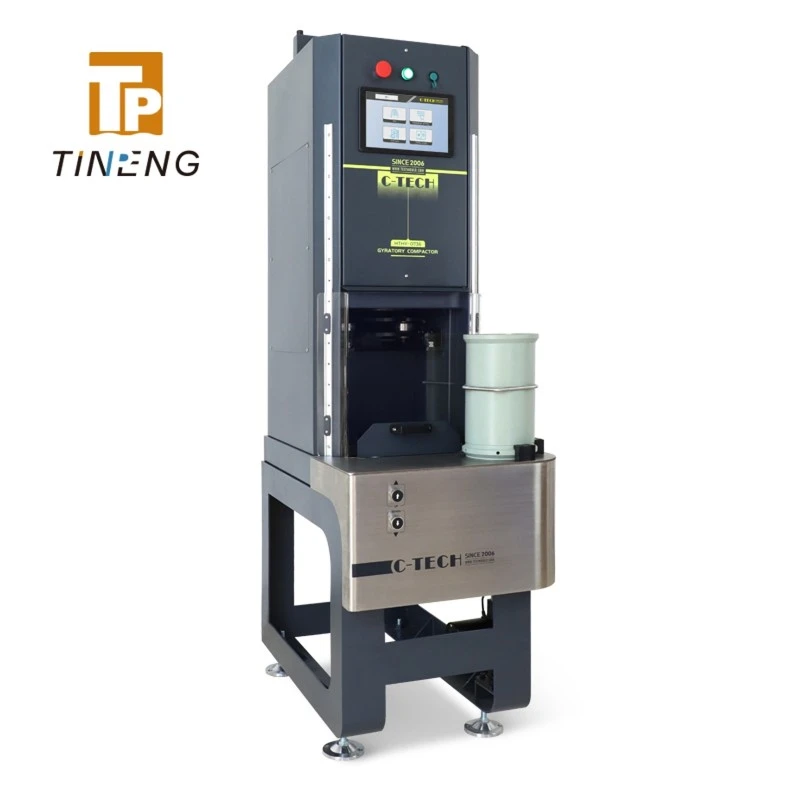
Gyratory-compacted specimens provide a controlled basis for evaluating asphalt mixture volumetric and performance characteristics. The results should be interpreted together with the aggregate blend and binder properties used in the mixture.
Using Extraction and Gradation Results for Asphalt Production Control
During asphalt production, engineers need to confirm that the mixture being manufactured remains consistent with the approved job mix formula. If the asphalt content or aggregate gradation changes, the mixture may behave differently during placement and compaction.
An extraction or ignition procedure can be used to determine asphalt binder content and recover or characterize the aggregate fraction, depending on the selected method. The recovered aggregate can then be examined to assess whether the production gradation is consistent with the target blend.
Tianpeng's Asphalt Mix Analyzer, models HTHY-8159/8159A, is listed for EN 12697-1 and ASTM D8159. Its product description identifies asphalt binder extraction and separation of mineral material from asphalt mixtures as its main application. The recovered aggregate can be further sieved for gradation analysis.
This creates a practical link between the aggregate data used in mixture design and the material actually produced at the asphalt plant. If the recovered gradation differs from the approved blend, engineers can investigate changes in aggregate feeders, stockpile handling, material segregation, or the supply source.
The result should not be interpreted in isolation. Sampling errors, incomplete extraction, aggregate breakdown, and differences in test procedures may also affect the comparison. Consistent sampling and the same calculation basis are essential when comparing production results with the job mix formula.
How Aggregate Test Results Are Applied in Road Base and Pavement Construction
Aggregate is also used in unbound base and sub-base layers, where it forms a granular structure that distributes traffic loads and provides support for the pavement above. In these applications, the engineering objective is different from that of concrete or asphalt: the aggregate layer must provide suitable load distribution, stability, drainage, and resistance to construction and traffic-related degradation.
Using Grading and Particle Shape Results to Control Base-Layer Stability
The grading of unbound aggregate affects particle packing, void distribution, and the ability of the material to compact into a stable layer. A suitable range of particle sizes allows smaller particles to fill spaces between larger particles, while the larger particles contribute to the load-bearing skeleton.
If the material contains excessive fines, drainage may be restricted and moisture sensitivity may increase, depending on the nature of the fines and the design requirements. If the material is too coarse or poorly graded, it may be difficult to achieve the required density and a stable surface.
Particle shape also matters. Excessively flat or elongated particles may orient during compaction or break under construction loads, changing the structure of the layer. Engineers should interpret grading and shape results alongside field compaction measurements and the specified acceptance criteria.
Connecting Laboratory Results with Field Compaction and Bearing Performance
Laboratory aggregate tests describe material characteristics under controlled conditions. They do not directly measure the actual bearing performance of a completed road layer. Field density, moisture condition, layer thickness, compaction equipment, and underlying subgrade support all influence the final result.
For example, a base material may have an acceptable laboratory grading but still fail to achieve the required field density because its moisture condition is unsuitable or the compaction procedure is inconsistent. Similarly, a weak subgrade may cause excessive deformation even when the aggregate base material meets its laboratory requirements.
The correct approach is to use aggregate testing for material qualification and field testing for construction verification. If field performance is unsatisfactory, engineers should investigate the aggregate source, moisture, layer thickness, compaction energy, and underlying ground conditions before deciding which corrective action is appropriate.
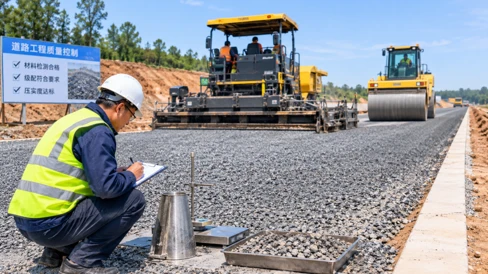
Laboratory aggregate results help establish material suitability, while field inspection confirms whether the material has been placed and compacted correctly. Both forms of evidence are needed for reliable pavement construction.
Using Aggregate Results to Investigate Pavement Distress
When pavement develops rutting, ravelling, cracking, or surface polishing, aggregate properties may be part of the investigation. However, engineers should avoid attributing every pavement defect to aggregate quality.
Rutting in asphalt layers can be associated with aggregate structure, binder properties, mixture composition, compaction, temperature, and traffic loading. Ravelling may involve inadequate binder content, poor adhesion, ageing, moisture damage, or aggregate loss. Surface polishing can reduce friction even when the aggregate particles remain mechanically intact.
A useful investigation compares the original material acceptance data, the approved mixture design, production test results, construction records, and field observations. Where possible, samples from affected areas should be compared with material from satisfactory sections. This helps distinguish a material-related problem from a production or construction problem.
How Engineers Turn Aggregate Test Data into Practical Quality-Control Decisions
The value of aggregate testing depends on how results are recorded, compared, and acted upon. A single result may indicate compliance, but a series of results can reveal trends that help prevent problems before they affect construction.
Compare Results with Specifications and Historical Data
Engineers should first compare each result with the applicable project specification and test method. They should then examine historical results from the same source and production process. A material may remain within the permitted range while showing a gradual shift that deserves attention.
For example, a quarry may produce aggregate that still satisfies the specified grading envelope, but the proportion passing a key sieve may be moving consistently toward one boundary. This trend may indicate a change in crushing conditions, screening efficiency, or stockpile composition. Early investigation gives the producer an opportunity to correct the process before the material becomes non-compliant.
Link Laboratory Results to Production and Construction Records
Test reports should identify the material source, sampling location, sampling date, aggregate fraction, test method, standard edition, and relevant production batch. Without this information, engineers may compare results from different sources or sampling conditions and draw incorrect conclusions.
The following table shows how common findings can be translated into engineering actions.
|
Test finding |
Possible engineering implication |
Practical response |
|
Combined grading shifts outside the target range |
Aggregate blend or production process may have changed |
Review stockpiles, feeder settings, and blend proportions |
|
Fine aggregate moisture changes significantly |
Effective concrete batch water may change |
Update moisture corrections and batch records |
|
Asphalt recovered gradation differs from the job mix formula |
Production aggregate proportions may be inconsistent |
Check cold-feed settings, material segregation, and sampling |
|
Aggregate shows signs of poor durability |
Long-term exposure performance may be at risk |
Review the exposure conditions and specified durability requirements |
|
Field density is below the specified requirement |
Material, moisture, or compaction process may be unsuitable |
Check moisture, layer thickness, compaction procedure, and subgrade condition |
The table is a troubleshooting guide rather than a set of automatic pass-or-fail rules. The final decision must follow the relevant specification and the engineer's assessment of the project conditions.
Summary and Recommendations
Aggregate test results support decisions throughout the construction process. In concrete production, they help engineers control grading, moisture corrections, material suitability, and durability risks. In asphalt mixture design, they contribute to aggregate blending, mixture stability, compaction assessment, and production quality control. In road base and pavement construction, they help establish material acceptance criteria and investigate problems that arise during field placement or service.
The most important principle is that aggregate test results should be interpreted in context. A satisfactory grading result does not guarantee good concrete workability, a favourable aggregate property does not guarantee asphalt rutting resistance, and laboratory compliance does not automatically prove that a completed pavement layer has been compacted correctly.
Engineers should connect material test reports with mixture design data, production records, field measurements, and performance observations. When an unexpected result occurs, they should investigate the material source, sampling procedure, test method, and construction process before making adjustments. This approach turns aggregate testing from a routine inspection activity into a practical tool for improving construction quality.
Tianpeng provides a range of Rock and Aggregate Testing Equipment, Concrete Testing Equipment, and Asphalt Testing Equipment for laboratories and construction-material quality-control applications. Its asphalt mixture testing range includes equipment for specimen preparation and mixture analysis, supporting the evaluation of materials beyond the initial aggregate test stage.
Frequently Asked Questions About the Use of Aggregate Test Results
1. How do aggregate test results affect concrete mix design?
Aggregate grading, moisture, absorption, and particle characteristics influence the proportions of aggregate, water, and cement paste required to achieve the target mixture properties. Engineers use these results to select aggregate blends, calculate moisture corrections, and assess material suitability.
2. Why are aggregate test results important in asphalt mixture design?
Aggregate properties influence the mineral skeleton, particle interlock, mixture void structure, and resistance to mechanical degradation. Engineers use the results to develop aggregate blends and interpret mixture-level test performance under controlled laboratory conditions.
3. Can laboratory aggregate results guarantee road pavement performance?
No. Laboratory results describe selected material properties under defined test conditions. Actual pavement performance also depends on binder characteristics, mixture design, construction quality, compaction, drainage, traffic, temperature, and the condition of the underlying layers.
4. What should engineers do when aggregate test results change during production?
They should confirm the sampling and testing procedures, compare the results with historical data, and investigate changes in the material source, stockpile condition, crushing process, screening, and production settings. Corrective action should be based on the cause of the change rather than on the test result alone.
5. How are aggregate testing and asphalt mixture testing different?
Aggregate testing evaluates the properties of the mineral materials before or during mixture production. Asphalt mixture testing evaluates the combined material containing aggregate and binder. Both are necessary because acceptable aggregate properties do not automatically guarantee that the final asphalt mixture will meet its design and performance requirements.
For more product information, technical specifications, or expert consultation on our advanced asphalt testing equipment, please contact our specialist team today at Zhuozhou Tianpeng.