

What Is the California Bearing Ratio Test and What Does It Measure?
The California Bearing Ratio test is an empirical penetration test used to evaluate the strength of soil and granular materials under a defined loading condition. During the test, a cylindrical penetration piston is pressed into a prepared soil specimen at a controlled rate. The force required to achieve specified penetration depths is recorded and compared with the standard resistance of crushed stone.
The resulting CBR value is expressed as a percentage. A higher value generally indicates greater resistance to penetration, while a lower value suggests that the material may provide less support to pavement layers under the test conditions.
The CBR test is commonly used in flexible pavement design because the strength of the subgrade directly affects pavement thickness and structural performance. If the supporting soil has low bearing resistance, traffic loads can produce greater deformation in the pavement system. This may contribute to rutting, settlement, and premature pavement deterioration.
The test is covered by standards including ASTM D1883, AASHTO T 193, and EN 13286-47. The applicable method should be selected according to the project specification and the requirements of the relevant road authority.
Why Subgrade Strength Matters in Pavement Engineering
The subgrade is the prepared soil layer that supports the pavement structure. Its engineering performance depends on soil type, density, moisture condition, drainage, and the stress imposed by traffic.
A weak or moisture-sensitive subgrade can deform under repeated wheel loads. Even when the asphalt or concrete surface layer is properly constructed, inadequate support beneath it can lead to uneven settlement, cracking, and rutting.
The CBR value provides a practical index for comparing subgrade materials and estimating their suitability for pavement construction. It is particularly useful during preliminary investigation, material selection, and laboratory verification of proposed earthworks.
However, CBR is not a direct measurement of elastic modulus or a complete description of soil behavior under repeated traffic loading. For projects requiring detailed pavement response analysis, engineers may also need resilient modulus testing, field deflection measurements, or other geotechnical investigations.
How Is the California Bearing Ratio Test Performed?
A reliable CBR result depends on specimen preparation as much as on the testing machine. The soil must be representative of the material being evaluated, and the target moisture content and compaction level should reflect the project requirements.
Preparing and Compacting the Soil Specimen
The soil sample is first processed according to the selected test method, including the specified particle-size requirements. The material is mixed with a controlled quantity of water and compacted into a standard CBR mould. The compaction procedure should correspond to the specified effort and target dry density.
The relationship between moisture content and dry density is normally established through a compaction test, such as ASTM D698 or ASTM D1557. This information helps the laboratory prepare CBR specimens at the required moisture condition and percentage of maximum dry density.
For pavement design, testing only one specimen at an arbitrary moisture content may not provide enough information. Where moisture sensitivity is important, specimens should be prepared at several water contents or at the moisture conditions specified by the project.
Soaked and Unsoaked CBR Testing
One important decision is whether the specimen should be soaked before penetration. A soaked CBR test evaluates the material after exposure to water under the specified laboratory procedure. This can be important for road subgrades that may experience prolonged wet conditions, seasonal groundwater changes, or poor drainage.
An unsoaked CBR test measures the resistance of the specimen in its prepared moisture condition. It may be appropriate where the project specification requires it or where the expected service condition justifies that approach.
|
Test condition |
What it evaluates |
Typical engineering application |
|
Unsoaked CBR |
Penetration resistance at the prepared moisture condition |
Initial material comparison and specified construction conditions |
|
Soaked CBR |
Penetration resistance after the specified soaking procedure |
Moisture-sensitive subgrades and conservative pavement assessment |
|
CBR at different moisture contents |
Variation in penetration resistance as water content changes |
Evaluating moisture sensitivity and field compaction limits |
The soaking procedure, surcharge weights, and measurement schedule must follow the selected standard. Engineers should not compare soaked and unsoaked results without clearly identifying the specimen condition.

Specimen preparation and moisture conditioning are essential parts of the CBR procedure. The test result is meaningful only when the preparation conditions are documented and consistent.
Applying the Penetration Load and Recording Measurements
After specimen preparation and any required soaking, the mould is positioned in the CBR testing machine. A penetration piston with a nominal end diameter of approximately 50 mm is brought into contact with the soil surface. The machine then applies a controlled load while the penetration and corresponding force are recorded.
Under ASTM D1883, the penetration rate is approximately 1.27 mm/min. Load readings are recorded at specified penetration intervals to establish a load-penetration curve.
The curve is important because the initial portion may be affected by surface irregularities or seating effects. If the curve is concave upward, the origin may need to be corrected according to the standard before calculating the CBR value.
How Is the CBR Value Calculated?
The CBR value is calculated by comparing the corrected pressure required to produce a specified penetration with the standard pressure for the reference material at the same penetration.
The commonly used calculation is:
CBR (%) = (Corrected test pressure / Standard reference pressure) × 100
For the two principal penetration depths, the standard reference pressures are approximately:
|
Penetration depth |
Standard reference pressure |
Approximate equivalent |
|
2.54 mm (0.10 in.) |
6.9 MPa |
1,000 psi |
|
5.08 mm (0.20 in.) |
10.3 MPa |
1,500 psi |
Why Are 2.5 mm and 5.0 mm Penetration Values Both Checked?
The CBR value is generally selected from the result at 2.54 mm penetration. However, if the value calculated at 5.08 mm is higher, the test should be repeated according to the standard. If the repeat test confirms a similar result, the value at 5.08 mm may be adopted.
This rule is important because an unexpectedly high result at the deeper penetration may indicate irregular specimen behavior, surface seating effects, or material characteristics that require verification. Selecting the higher number without checking the load-penetration curve can produce an unreliable design input.
Interpreting CBR Values in Engineering Practice
CBR values are often used to compare materials and support pavement design decisions. The following table provides broad illustrative ranges rather than universal acceptance limits. Actual requirements depend on the pavement design method, traffic level, material specification, and local road authority.
|
Approximate CBR range |
General indication |
Possible engineering consideration |
|
Below 3% |
Very weak bearing resistance |
Stabilization, replacement, or additional ground improvement may be considered |
|
3–5% |
Low bearing resistance |
Moisture control and subgrade improvement may be necessary |
|
5–10% |
Moderate bearing resistance |
Suitability depends on pavement loading and design requirements |
|
10–20% |
Relatively good bearing resistance |
May be suitable for certain subgrade or selected fill applications |
|
Above 20% |
High penetration resistance |
May be considered for stronger subgrade or granular pavement layers, subject to grading and durability requirements |
A CBR value should never be interpreted in isolation. For example, a granular soil may show relatively high penetration resistance when dry but lose strength after becoming saturated. In that situation, the soaked CBR may be more relevant to long-term pavement performance.
Which Factors Have the Greatest Influence on CBR Test Results?
CBR is sensitive to specimen preparation and soil condition. Two tests performed on material from the same source can produce noticeably different results if moisture content, compaction effort, or particle-size distribution differs.
Moisture Content and Degree of Compaction
Water content is one of the most important variables affecting soil resistance. In fine-grained soils, increasing moisture content can reduce suction and effective interparticle resistance, making the material more susceptible to deformation. The degree of compaction also affects particle arrangement and the density of the specimen.
For meaningful comparison, the laboratory should record the initial water content, dry density, compaction effort, and soaking condition. Where the project specifies a minimum field compaction percentage, the design CBR should be evaluated at the corresponding dry density rather than automatically using the maximum dry density.
Soil Gradation and Oversized Particles
The proportion of gravel, sand, silt, and clay influences the penetration response. Materials containing substantial coarse particles can produce more variable results because the penetration piston may encounter individual particles or local differences in particle arrangement.
ASTM D1883 provides procedures for materials with larger particles, including gradation modification in specified circumstances. However, modifying the gradation can change the strength characteristics of the tested material. The laboratory report should therefore identify any sample processing or gradation adjustment.
Drainage and Field Conditions
Laboratory CBR results represent a defined specimen condition. Actual road subgrades may experience variable groundwater levels, rainfall, drainage performance, seasonal moisture changes, and repeated traffic loading.
A laboratory result should therefore be considered together with field investigation. Where the project requires in-situ assessment, a field CBR method or a dynamic cone penetrometer may provide additional information.
Which CBR Testing Equipment Is Suitable for Laboratory and Field Evaluation?
The testing machine must provide stable loading, suitable capacity, and reliable measurement of penetration and force. The choice between manual and automatic equipment depends on the laboratory's testing volume, required data recording, and project specifications.
Automatic CBR Test Machine CTM-02
Tianpeng's Automatic CBR Test Machine CTM-02 is designed for laboratory evaluation of soil subgrades and base-course materials. Its servo motor control supports stable loading, while the 7-inch touch screen displays test parameters and data.
The listed maximum load is 50 kN, with a load precision of 0.001 kN and a load speed range of 1–5 mm/min. The penetration rod has a 50 mm end diameter, and the listed test mould dimensions are 152 × 177.8 mm. The CBR mould needs to be ordered separately.
The CTM-02 is listed for BS 1377, BS 1924, EN 13286-47, ASTM D1883, and AASHTO T193 applications. The selected test procedure and operating settings should always be checked against the current project specification.
Manual CBR Test Machine CTM-01
For laboratories that prefer a manual loading arrangement, Tianpeng also offers the CBR Test Machine CTM-01. It uses a two-column frame with an adjustable upper beam, proving ring, penetration bar, and loading plate.
Its selectable capacity is 30 kN or 50 kN, and the listed loading speed is 1.0 mm/min. Dial indicators and the CBR mould need to be ordered separately. Laboratories should confirm that the selected configuration provides the measurement arrangement required by their test method.
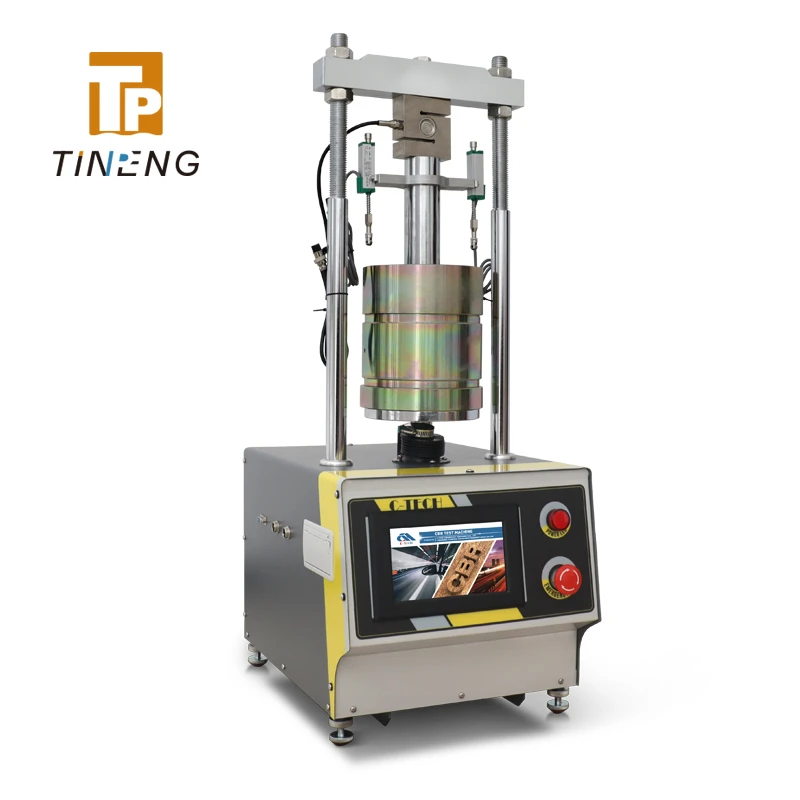
An automatic CBR testing machine provides controlled loading and convenient data display. The mould, accessories, and measurement configuration should be selected according to the required test method.
In-Situ CBR Evaluation and Supporting Field Equipment
Laboratory testing is not the only way to investigate pavement support. Tianpeng's In-situ CBR Test Apparatus LCB-2 is designed for field determination of the CBR of soil base materials. Its working principle uses the rear axle load of a truck, with a hydraulic jack applying the load through a penetration rod while the penetration and load are measured.
Another useful field instrument is the Dynamic Cone Penetrometer 16-T0012/C. It measures penetration under repeated impact and can be used to identify changes in the strength of unbound pavement layers. Correlations between DCP measurements and CBR have been established in engineering practice, but they should be applied only when suitable local or project-specific correlations are available.
How Should Engineers Apply CBR Results in Pavement Design?
A reliable pavement design should use a CBR value that represents the expected field condition rather than simply selecting the highest laboratory result. Engineers should consider the soil source, moisture condition, compaction specification, drainage environment, and anticipated traffic loading.
Where subgrade materials vary along the road alignment, testing should cover representative locations and soil types. A single CBR result may not adequately describe a long road section containing different geological or moisture conditions.
For construction quality control, the laboratory should establish the relationship between CBR, moisture content, and dry density where required. Field density and moisture measurements can then be compared with the approved construction requirements. If field conditions differ substantially from the laboratory assumptions, additional testing or engineering review may be necessary.
Understanding the Role of Standards and CE Marking
ASTM D1883, AASHTO T193, and EN 13286-47 describe test procedures or requirements relevant to CBR evaluation. Laboratories should use the current edition required by the project and ensure that equipment capacity, loading rate, mould dimensions, and measurement devices are appropriate.
CE marking is a separate regulatory conformity matter, not a CBR test method or a guarantee of test accuracy. For equipment supplied to the European market, the applicable legislation and manufacturer documentation should be reviewed. The European Commission explains the principles and responsibilities of CE marking.
Summary and Recommendations
The California Bearing Ratio test evaluates subgrade strength by measuring the resistance of compacted soil to a standard penetration piston. Its value is widely used in flexible pavement engineering to compare subgrade, subbase, and base-course materials and to support pavement thickness decisions.
For dependable results, engineers should pay close attention to specimen preparation, moisture conditioning, compaction level, penetration measurements, and the interpretation of the load-penetration curve. Both the 2.54 mm and 5.08 mm penetration values should be checked according to the applicable standard.
Tianpeng's CTM-01 and CTM-02 provide laboratory CBR testing options, while the LCB-2 and dynamic cone penetrometer support field investigation. The best equipment choice depends on whether the project requires controlled laboratory testing, field evaluation, or both.
Ultimately, CBR should be treated as an engineering index rather than a complete description of pavement behavior. Combining laboratory results with field conditions, drainage assessment, compaction control, and appropriate pavement design procedures leads to more reliable subgrade evaluation.
Frequently Asked Questions About the California Bearing Ratio Test
FAQ 1: What does a CBR value indicate?
A CBR value indicates the penetration resistance of a soil specimen relative to a standard reference material. A higher value generally represents greater resistance under the specified test conditions, but it does not directly equal the soil's elastic modulus or overall structural capacity.
FAQ 2: What is the difference between soaked and unsoaked CBR?
Unsoaked CBR measures the specimen in its prepared moisture condition, while soaked CBR measures resistance after the specified soaking procedure. Soaked testing is particularly relevant when the subgrade may experience prolonged wet conditions or saturation.
FAQ 3: Why are CBR values measured at both 2.5 mm and 5.0 mm penetration?
The two penetration depths are used to calculate CBR values against their respective standard reference pressures. The 2.54 mm result is generally selected, but if the 5.08 mm value is higher, the test should be repeated and interpreted according to the standard.
FAQ 4: Which machine is used for a laboratory CBR test?
A laboratory CBR test uses a CBR testing machine with a loading frame, penetration piston, load-measuring device, and penetration-measuring arrangement. Automatic and manual machines are available, depending on the required testing procedure and laboratory workflow.
FAQ 5: Can a dynamic cone penetrometer replace the CBR test?
Not directly. A dynamic cone penetrometer provides field penetration measurements that may be correlated with CBR through suitable empirical relationships. It is useful for rapid in-situ investigation, but the correlation must be appropriate for the soil type and project conditions.
For more product information, technical specifications, or expert consultation on our advanced asphalt testing equipment, please contact our specialist team today at Zhuozhou Tianpeng.